June AD 964. Kaupang, southern Norway.
It was a cold night, but almost as bright as day, for the sun barely set in Norway during the summer months. Grimnir slipped through the busy streets of Kaupang, weaving among the wooden shacks and market stalls, hay wagons and cattle pens. His black hood was pulled down low over his face, in a way that suggested he did not want to be recognized. His ragged black cloak flapped open as he walked, revealing threadbare black robes, cut straight and long, and the outlines of a gaunt, emaciated body. Though he was lean and poorly dressed, he gave no sign that he felt the piercing wind blowing off the sea.
He went wherever the crowd was thickest, the eyes beneath his hood darting left and right, scanning the faces of the passers-by. The streets were thronged with groups of revellers, laughing and talking in loud voices, locals and visitors carousing for as long as the summer night would allow. Nobody gave him a second glance. Almost anywhere else he might have attracted curious stares, for whereas Norsemen commonly went about in woollen shirts and trousers, Grimnir always wore a long dark habit which gave him the look of a monk or a religious vagrant. But he did not stand out in Kaupang, a busy trading port full of foreign merchants, many of whom came from the east and were exotically dressed in long robes and skull caps.
Woodsmoke and the smell of livestock hung in the air and the clatter of pots and cooking-smells drifted from the open doorways. From a large, squat timber house across the street came the stench of stale beer and the noise of rowdy singing and laughter. Grimnir stopped outside. It sounded as though the place was packed.
Stooping a little, he peered through the low doorway. The only light came from the fire which burnt in the centre of the room in a large hearth, surrounded by an earthen floor which was filthy and unswept. Two pairs of posts supported the roof and wooden benches and tables lined the walls along both sides. At the centre of the right-hand aisle a young man in shabby clothes and a long-tailed hat was talking animatedly to a small audience who were listening closely to his story and every now and then burst into guffaws of laughter. At the far end, in a dark corner, two burly men were playing dice while their companion sat with his head thrown back and eyes closed, snoring loudly. Opposite them, on the other side of the room, a corpulant, sweaty-faced man was fondling a woman in a tight-fitting gown who sat on his lap, and a dozen other drinkers lounged on the benches, conversing in groups, or keeping a sullen silence, while a young boy moved about, refilling their cups in exchange for payment. The landlord, a balding man with a thick grey moustache, who wore a beer-stained apron stretched tightly across his barrel belly, came out of the back room at that moment, carrying two large jugs of ale which he placed on a sideboard.
As Grimnir ducked through the doorway, the room grew quieter as several of the men broke off what they were doing and turned to look at the tall, dark, hooded stranger who had entered. They stared at him with sour, wary faces. Grimnir crossed the room and went over to the sideboard, where he took up a relaxed position, resting one elbow on the counter as if waiting quietly to be served. The other customers soon lost interest in him and resumed their conversations, and the volume of noise in the room gradually rose again.
Grimnir laid a quarter of a penny on the sticky counter. The landlord silently poured him a drink of ale, then reached down to take a bowl of pickled herring from a low shelf and placed it beside the cup.
‘If you’re lookin’ for a bed for the night, we’re already full,’ he told Grimnir, who had the appearance of a traveller from a foreign land, though he carried no bag.
Grimnir looked at him in silence, then said in a discreet, rather dry voice, ‘I’m trying to trace a cargo ship. The Swan. She might have docked here any time in the last couple of months.’
The landlord, a solid, phlegmatic man, folded his arms and shifted his weight from one foot to the other. He stared at the stranger stolidly, as though he were not in the least taken aback by his manner of speech, which marked him out as a person of quality, not the usual sort who came in off the street—though to judge by his clothes he was very poor, even destitute. There was something odd about him. He was an oddball, no doubt about it.
‘Well, that’s hard to say,’ he said in reply, ‘what with it being a busy time of year—ships comin’ and goin’ every day, from all parts of the world.’
‘This one belongs to a northerner, a chieftain from Lofoten,’ said Grimnir. ‘A fur and ivory trader. Used to come down south once a year to sell his goods.’
‘We’ve had no ships from the far north these past couple of months—that much I can tell you. I heard there was trouble up there. Perhaps it’s preventing ships from getting through.’
‘This one got through. Halfdan Hjorvardsson is the chieftain’s name—maybe you know him? His son, aged twelve, was travelling with him. A couple of servants were on board too, probably more. One was a woman.’
The landlord shook his head. ‘Can’t recall him ever coming in here.’
‘Are you sure?’
The landlord shrugged, incurious. ‘We get all sorts. They don’t always tell me their names. You should try up in Trondheim. He’ll have friends and contacts there.’
‘I have already. No one’s seen him.’
‘Friend of yours, is he?’ asked the landlord.
‘Oh yes,’ Grimnir hissed. ‘Halfdan and me, we’re like that.’ He held up two bony fingers pressed tightly together.
Before the landlord could reply, a large crowd of people came in from the street, laughing and making a noise, and crowded round the counter, pushing, jostling, and shouting out their orders. The landlord moved away to serve them.
Grimnir took his drink but left the fish untouched and went to sit at one of the tables. He took a small pouch and a pipe from inside his cloak, and filled the bowl unhurriedly. He struck a light with his flint and steel and, sheltering the spark, held the glowing tinder to the leaf, puffing gently to coax it into life. The sweet aroma of pipe smoke filled his nostrils, masking the beery stench in the warm, stuffy room.
A fly landed on the rim of the cup. It crawled a little way, tasting the sticky sweetness, and sat opposite Grimnir, rubbing its forelegs against its head. ‘I have a good idea where they are,’ Grimnir confided under his breath. ‘But it isn’t time to act yet. These little games are a way of relieving the tedium. You know how it is: when you’re on a job, it’s important to act the part at all times.’
The fly took off and twisted its way back through the room and out into the street. Grimnir reclined against the wall in an attitude of ease, his eyelids half-closed beneath his hood, and watched the entertainer tell his story. When it came to an end, everyone laughed. The young man stood up, swept off his hat, and bowed to his audience.
‘Thank you, good people, thank you. You have been listening to Skapti the storyteller, purveyor of marvellous tales, gossip and scandal, and all the latest news.’
He passed the hat round for a collection. Two people dropped pennies in, but the rest got up and moved away before the hat reached them. Skapti looked slightly annoyed and disappointed when he came to examine his earnings.
Grimnir picked up his drink and walked over to the storyteller’s table. Without waiting to be invited, he sat down opposite him in the place that had just been vacated. He said nothing but examined him intently. Skapti gazed back at him, surprised by this sudden imposition. Beneath the hood he glimpsed a sharp nose and cheekbones accentuated by taut, almost waxy skin and a well-defined lower jaw, speckled with colourless stubble. The eyes lay in shadow. He could have been a trader from Rus or the east, but he carried no weapons and dressed like an Irish hermit.
The silence lasted a long moment until the storyteller, recollecting his manners or recognizing a business opportunity, ruffled his light-brown hair, replaced his hat, and
addressed the stranger with a smile.
‘Good evening, sir. What would you like? A scurrilous tale? The latest gossip about the rich and famous? A good old-fashioned tale of adventure, or’—he leaned across the table and lowered his voice to a whisper—‘something a bit more spicy?’
As if in answer, Grimnir raised his hands and slowly drew back his hood. Piercing black eyes glittered out of the deep sockets of his face. A curious tattoo was painted on the bones just below the eyes—the three dark-blue dots on either side. They added a touch of colour to the hollow cheeks, but also highlighted the already too prominent contours of his skull.
‘I beg your pardon, sir,’ said the storyteller, quailing under Grimnir’s icy black stare. ‘I didn’t mean to suggest that … to cause offence. I can see now that you’re a scholar or a priest, a man of learning, and not at all interested in gossip or scandal. Some lines of poetic wisdom would be more to your taste …’
Grimnir took a long pull at his pipe and let the smoke seep slowly out of his nostrils.
‘Actually, I’m after some information,’ he said in his withered voice. ‘You’re a sharp-witted, observant fellow, an entertainer. You get around a bit, I dare say.’
Skapti nodded. ‘Just arrived last week—from Iceland.’
‘Perhaps you came across a cargo ship on your travels? The Swan. Captain would’ve been a man in his forties. A fur trader from the north of Norway. His son, aged twelve, was on board, several servants too.’
Skapti thought hard, then slowly shook his head.
‘He’s a chieftain,’ Grimnir added. ‘Halfdan is his name, Hjorvard was his father.’
‘Hjorvardsson,’ the young man murmured to himself. His face suddenly brightened, then clouded over with a frown. ‘It might just be a coincidence. Then again … I might be able to help you.’
He looked at Grimnir expectantly. Grimnir pushed a small silver coin towards him across the table.
The storyteller propped his elbows on the dirty table and leaned in closer, his large brown eyes bright and eager in his narrow, pale face.
‘We put in at the Faroes on our way over. While we were there I heard that a ship had stopped there a couple of months before. The captain was very tight-lipped. Wouldn’t say where they were bound or where they’d come from. Wouldn’t even let anyone off the ship. But there was an old Irishman on board who hung over the side and talked to the fishermen on the quay. He said they had suffered terrible persecution at the hands of their enemies and his master had lost everything, his whole estate and all his fortune! And he said they were going to … now where was it? My memory’s a little hazy.’
He frowned as if trying to remember, tossing the small coin in his hand. Grimnir reached inside his cloak and took out a larger silver piece, which caught a glint of firelight as he held it out. Skapti’s eyes widened and lit up when he saw it.
‘It’s all coming back to me now,’ he said, snatching the coin from Grimnir and pocketing it. ‘He said they were going to Iceland to start a new life. His master had family in Iceland—a brother. Now, what was the brother’s name?’
He paused and stroked his hairless chin thoughtfully. Grimnir’s scrawny hand shot out and caught him by the wrist. He yanked it hard, pulling him closer, his fingers gripping and twisting like iron pincers. Skapti squealed in pain.
‘Give me the full story, and don’t piss me about,’ Grimnir said in a harsh, rough voice.
‘Arnor! Arnor Hjorvardsson!’ cried the boy, squirming in his seat.
As soon as he heard the name, Grimnir let go of his arm, apparently satisfied.
The storyteller rubbed his wrist which tingled unpleasantly from the man’s sharp, bony grasp, and looked at Grimnir resentfully, with red-rimmed, watery eyes.
‘Where in Iceland?’ asked Grimnir more softly.
‘He didn’t say. I’ve told you everything I know. That’s the truth, I swear.’ Skapti placed his hand on his heart.
Grimnir seemed to accept his word.
‘It looks as if your man has left the country,’ said Skapti, relaxing a little. ‘If I ever come across him back in Iceland, I’ll tell him you were looking for him.’
‘If you ever come across him, you’ll keep your mouth shut. I’d rather … surprise him,’ said Grimnir. His voice was quiet but carried an unmistakable note of menace.
The young man nodded, looking scared. ‘Oh, I’m not planning to go home, not yet, not for a long time! Soon as I’ve worked the crowds here, I’m moving on. I’m going west, all the way to Kinsarvik.’
Grimnir sat back and knocked the ashes from his pipe on to the floor.
‘The royal estate.’
Skapti nodded eagerly. ‘To seek an audience with the king. I’m a poet, you see. A skald. Most people don’t want to hear my verses. Pedlars, farmhands, drunken riff-raff—what do they know?’ He glanced around the room in disdain. ‘What I need is a wealthy, enlightened patron. I’d give anything to be a court poet. I’d sell my soul for that!’
‘That could perhaps be arranged,’ said Grimnir in a soft, dry whisper. He fixed the poet with a mysterious and unpleasant gaze. Then he pushed back his bench, got up from the table, and went out of the tavern without another word.
The skald shivered slightly as he watched him go. ‘I wouldn’t want to be in that Halfdan fellow’s shoes,’ he muttered to himself.
The old man’s beer stood on the table, entirely untouched. With a surreptitious glance towards the door, Skapti lifted it to his lips and drank it down in one go. He set the empty cup on the table and wiped his mouth on his sleeve with a happy sigh. It had been a profitable evening. He took out the silver piece and spun it on the table. It weighed an ounce at least.
Two stocky men approached the bench, reeling slightly. Skapti hastily tucked the coin away. The men sat down opposite him. One had a look of low cunning, the other was flabby and bloated with a dull expression. Their eyes were bloodshot and their faces flushed with drink.
‘We were just admiring that nice silver coin of yours.’
The poet lowered his eyes and said nothing.
‘Maybe you should put it to good use and buy us a drink.’
‘Maybe I should,’ replied the poet slowly. ‘Then again, maybe you’d be better off going after the old man who gave it to me.’
‘Maybe I should give you a good punch on the nose,’ cried the flabby man, getting to his feet with his fist clenched, but his friend pushed him back down. ‘Hang on. Tell us more.’
‘The old man who just left wants information about a cargo ship called the Swan and he’s willing to pay good money for it. I were you, I wouldn’t let the bigger catch get away. Go after him—he can’t have gone far. Spin him a yarn. Make something up.’
The two men exchanged a look and got up and hurried to the door. As soon as they had gone, Skapti the Poet slipped out the back and vanished among the houses.
* * *
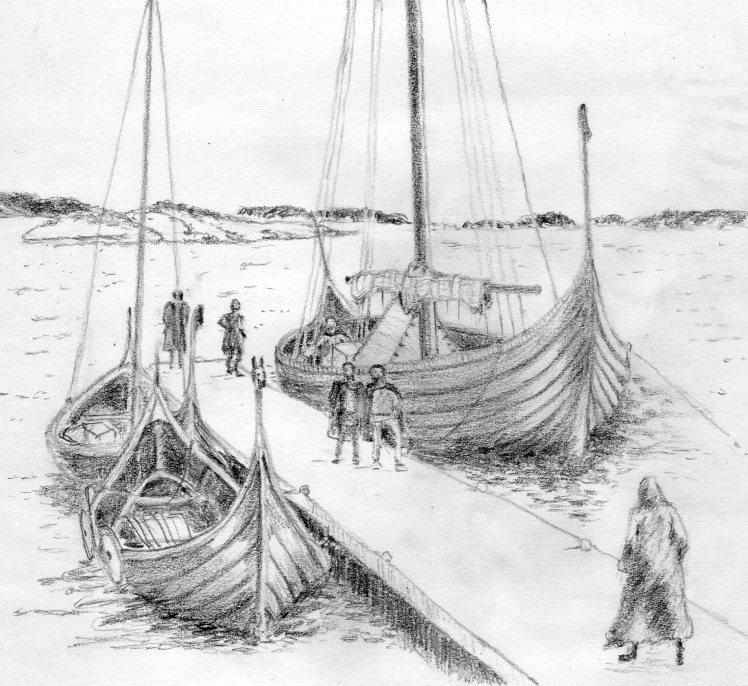
Although it was well past midnight, it was still almost full daylight. Grimnir stood on the waterfront, looking at the ships that lay in the sheltered inlet under the golden pink sky. Two narrow longships and four deep-sea traders were moored there, each vessel curved high at either end where the keel ran up into an ornamented stem. None of them was bound for Iceland. Freyja’s Wagon, the merchant ship that had arrived from the Hebrides a fortnight ago, lay lower in the water than the others. The crew, a small band of strong, heavy men with weathered faces and forked beards, had just finished loading a new cargo. Two of them kept watch over the side of the ship; the other four idled on the jetty, wrapped in their heavy cloaks, their shoulders hunched against the cold sea-breeze. They were ready to leave and might be persuaded to change course …
Grimnir was about to go over and have a word with their captain, when he heard shouts coming from the direction of the town.
‘Hey! Hey, you there—old man!’
He glanced round and saw two men hastening towards him down the main street, with stumbling steps. They were about a hundred yards away. He turned left, moving out of their line of sight, and walked swiftly along the path that ran between the open-sided boathouses and the row of gabled fronts that faced the harbour. At the end of the row, he looked back over his shoulder. The men seemed intent on following him.
He could have given them the slip, but there was a chance that they could tell him something useful.
Grimnir took a left turn up a path that led him back into town, and found himself in a maze of irregular lanes. He walked briskly, stepping over the rubbish and foul-smelling slops that had been thrown out of the houses. Lights dotted the huts on either side, voices came from the shadows. It was quieter but there were still people about. A door opened ahead of him, casting a bar of yellow light, and letting out a man and a woman who hurried away up the lane, laughing, arm in arm. Behind him he could hear the heavy slap of two sets of feet as his pursuers splashed through the filth and mud. He quickened his pace, and turned up a deserted side street that afforded more shadow. Halfway along he came to an empty alley, which was bounded on one side by the long wall of a workshop, boarded with rough wooden planks, and on the other by a high wattle fence. The alley came to a dead end, blocked off by a locked gate. Tall wooden palings ran from either side of it and the upper part of a roofed hall was visible over the top. No doors or windows overlooked the passage. Whatever happened here, there would be no witnesses. It was safe to assume that any noise, shouts, or cries for help would not be heard and even if they were, no one would come rushing to offer assistance.
Grimnir walked to the end of the alley and waited. Moments later, the shapes of two men appeared silhouetted in the entrance, swaying slightly from side to side.
‘You led us a merry dance,’ said one accusingly.
‘We only wanna talk to you.’
‘Come on out. You wanna know about the Swan, don’t you?’
Grimnir did not move. Let them come to him, or let them go. It mattered little to him.
The two men advanced into the alley, slowly and mistrustfully. It would take them a dozen or so steps to reach him. Grimnir watched them come, his eyes gleaming with a strange phospherescence in the murky light.
‘Wha’ you looking at us like that for?’ demanded the flabby one, in a thick, slurred voice, as he took an unsteady step forward.
‘He’s afraid.’
‘Don’t be afraid, old man. We don’t wanna hurt you. Jus’ give us your purse an’ we’ll let you go.’
The flabby man came to a halt in front of Grimnir, a couple of paces away, and pulled an axe from his belt. His accomplice drew a long fish-gutting knife from a sheath at his side and in what was clearly a practised move, edged past the old man quickly, keeping a watchful eye on him and the knife pointed at him all the time.
‘Come on, let’s see your money.’ The flabby man held out his hand.
Grimnir did not stir from his place.
The flabby man made an impatient gesture. ‘Come on, you stupid or what?’
‘He’s old and ready to die,’ the man behind him chuckled, and emboldened by the idea of an easy target, he made a savage slash with the knife at the back of Grimnir’s knees, aiming to cripple him. The blade swept right through the old man’s long robes. The man wielding it expected it to make contact with his body but somehow it missed him. He could not even feel the rough edge of ripping cloth. He took a step forward—it was hard to judge in the dim light exactly how close he was—and was about to strike again when his companion brought up his axe and swung at Grimnir with all his clumsy strength. The blade swept diagonally through the old man’s body, from his right shoulder down to his left hip. His attacker threw all his weight behind the blow, expecting the axe to stick as it bit into bone and sinew, and when the blade met nothing but unresisting air, he almost staggered into Grimnir. It took him a moment to recover his balance. He reeled drunkenly back, expecting the body to drop to the ground, dead.
But the old man did not fall. He did not utter a sound. He just stood there, staring at his would-be assassin with a horrible sombre expression on his face.
The flabby man looked puzzled, and then annoyance came into his face and he cursed obscenely. He must have misjudged the distance or not aimed straight or something—the alley was shadowy and he was a little tipsy after all.
He made another great sweep with the axe. It sailed right through Grimnir’s head and came out through his chest, without encountering any resistance.
The old man didn’t flinch. He didn’t even blink. He stood before him as quiet and still as stone, as unyielding as death itself.
The flabby man stared first at the axe and then at Grimnir as if horribly fascinated. His tiny eyes were almost starting out of his head.
Before he knew what was happening, strong bony fingers had closed tight around his throat and the axe was wrenched from his limp and unresisting hand. He half heard, half felt against his cheek a dry, cold whisper of breath that smelt musty, like old pipe-smoke.
‘Now it’s my turn.’
* * *
By the time the two bodies were discovered, at dawn the next day, Freyja’s Wagon had already pulled out of the harbour. A group of fishermen came across them on the way down to their boats. One man lay sprawled on his face only a yard or two inside the alley, as if he had been brought down in mid-flight. The other lay towards the back of the alley, curled up on his side, his forehead split open by an axe which had lodged deep in his skull. Drunken brawls were fairly common in Kaupang during the summer months and sometimes resulted in killings. No one would have given it much thought, had it not been for the peculiar injuries on the first body—the man who lay in the entrance. Dozens of small, deep holes peppered his back, as though he had been caught in a storm of arrows fired by a whole company of archers. The killers had apparently gone to the trouble of picking the arrows out of the wounds before they left, but there was no evidence that either body had been robbed.
The fishermen concluded that the first man had killed the other with an axe, and was himself murdered while attempting to flee the scene, by persons unknown. Possibly elves who were punishing him for his offence.
Having reached a possible solution, they agreed to say no more about it. It was thought better not to pry into the matter too closely, in case the little people were listening and brought bad luck on their fishing.
 The Adventures of Helgi the Viking