The overnight rain which had kept Audun awake had cleared up by morning and by noon it was bright and warm. Helgi was in the stable, saddling Kol. He was looking forward to getting out because he had been grounded for more than a week—not because Gerda was punishing him (after a brief scolding, the matter of the driftwood had been forgotten) but because she had decided, on hearing about Audun’s near-fatal confrontation with the Ericssons, that it wasn’t safe for Helgi to go outside the farm.
Helgi had heard about the incident from his uncle, who had rushed over to the Forge to tell his father the news just after it had happened. ‘I’ve had just about enough of that man!’ Arnor had burst out, as he entered the living room. ‘That delinquent son of his has just attacked one of my farmhands! He threw an axe at Audun without the slightest provocation. Threw it right over the wall of the Manor—on my land, would you believe it! And that’s only the latest in a long line of insults I’ve had to endure from him!’
‘I told you that you could expect trouble if you opposed Eric,’ Halfdan had replied evenly, from his seat by the fire. ‘The question is, how far do you wish to take this matter? Do you intend to seek legal redress? Or will you answer it tit for tat and throw an axe at one of Eric’s men?’
Arnor had stopped still, breathing heavily, then shaken his head and looked despondent. ‘Audun wasn’t killed or injured. And he’s only a farmhand, not family. I’ll complain to Eric of course, but I don’t think he’ll agree to restrain Thorgrim. There isn’t a lot I can do …’
That had been over a week ago. Things had been quiet since then, so Gerda had decided it was safe to send Helgi on an off-site errand that afternoon. As a condition of being allowed out, she had made him promise to steer clear of trouble and keep well away from Eric’s estate, and Helgi had given her his word. She wanted him to fetch some bags of skyr from the dairy hut which lay a little way up the mountain. Skyr was a thick cream made of curdled milk; Helgi’s uncle Arnor owned many sheep which grazed in the upland pastures and provided milk for the two households.
Once he had got the heavy pack-saddle onto Kol’s back and fastened the straps around his girth, Helgi hung two panniers from the pegs on the side-bars of the saddle, so that he could carry the precious skyr home without spilling a drop. As he led Kol out of the stable into the bright sunlit yard, a young girl emerged from the farmhouse and ran towards him with her skirts and apron billowing, her long hair, which was dark gold and braided into two thick plaits, swinging behind her. She jingled as she ran, because she was wearing a collection of small useful articles—a clasp-knife, a pair of scissors, and a comb—that danced about on long thin chains, which were fastened to one of the apron brooches at her shoulder.
Embla was a native Icelander, the great-grand-daughter of an original settler, though she too was a newcomer to the area. She was the granddaughter of Jon the Lawman, who had offered to prosecute Eric if proof could be found that he had stolen Halfdan’s cargo. As a favour to his father’s old friend, and to thank him for his offer of help, Halfdan had offered to act as Embla’s guardian for a while. Jon felt that the change would do her good—his farmstead in the north-west was built on a lonely and desolate spot and there was no female company for her in his household since her mother had died. So Halfdan had brought her back with him from the north.
Gerda took the girl under her wing and Embla settled in happily at the Forge and quickly made friends in the neighbourhood. Her creamy skin and heavy-lidded grey eyes gave her a kind of solemn, pensive beauty, but by nature she was cheerful, forthright and unreserved, the sort of person who said what she thought and wasn’t afraid to hug and kiss people when she greeted them.
Thrown together as they were, Embla was probably the closest friend Helgi had made since coming to Iceland. He had not known many people of his own age before their exile. There had been a few children living in the warriors’ barracks on their estate back in Norway but they were all much younger than himself. He had no brothers or sisters and had grown up with only adults for company, but Embla was such a warm, friendly person that he soon got over his natural shyness. She was also a challenge, as far as he was concerned. Although she was only a few months older than him, she seemed more mature and grown-up than many of the adults he knew. She went about with an air of confidence. She was clever and strong-willed (‘bossy’, Helgi called her) and she liked to win. It was difficult to get the better of her in an argument, but Helgi made a point of disagreeing with her even when he knew she was right. He just couldn’t help it.
She ran up to him now, breathless with excitement, and said, ‘Helgi, the Ericssons were here again just now, looking for you! I told them you weren’t in. Thorgrim was really angry this time. He said you can’t keep avoiding him forever.’
Helgi felt his stomach contract in a spasm of fear.
‘I’m not avoiding him. I’m just not allowed to go near him after what he did to Audun. Does Gerda know they were here?’
‘No, she wasn’t around when they called.’
‘Good. Don’t tell her. I don’t want her to stop me going out.’
‘He wants to see you right now.’
‘Did he happen to mention why?’ Helgi asked lightly, trying not to betray his concern.
‘No, he just asked me if I knew where the Easterner was. I nearly died when I opened the door and saw three great mountain trolls glowering at me, bristling with weapons! The tall ugly one, Thorgrim, was looking pleased with himself as usual. The other two, Thorbrand and Thorstein, just stood there and let him do the talking. They were there as back-up, I think, in case you gave him any trouble.’
The idea of him posing a physical threat to Thorgrim was so absurd that Helgi couldn’t help laughing.
‘What have you done to upset them?’ Embla asked.
‘Nothing that I know of.’
‘I’ve told you before not to provoke them.’
‘I haven’t! They just don’t like me.’
‘No … I suppose you’re not the only one they pick on.’
‘Well, I can’t go and see Thorgrim now. I’ve got more important things to do,’ said Helgi. He bent down and tightened the saddlestraps under Kol’s belly.
‘I’m busy too,’ said Embla. ‘I’m working on a new remedy.’
‘Oh … right.’
Helgi could tell she wanted him to ask what kind of remedy it was, but he didn’t feel like getting drawn into her latest experiment. It would be a mistake to sound too interested.
Embla’s passion was concocting medicines. Most of her working hours were spent helping Gerda in the dairy or weaving woollen cloth, but whenever she had an opportunity she would sneak off along the coastal path to hunt for ingredients, and return exhausted but triumphant, clutching a bundle of strange-looking lichens, herbs and mosses, or samples of volcanic mud which she swore had medicinal powers if properly applied. She would stew the plant material into an unappetising brew and grind up the minerals to make hot or cold poultices. Some of her remedies worked very well, but it was rather hit-and-miss.
One evening, not long after he had got to know Embla, Helgi heard her trying to cajole the others in the house into testing her latest concoction. He couldn’t understand why the room suddenly emptied as everyone recalled urgent business they had to attend to. Embla flew into a temper: how could she possibly improve unless she had a patient to observe? One day people would be glad of her cures and would come from miles around to be healed! Her arguments made no impression on Malachi who hadn’t stirred from his place by the fire but flatly refused to be a tester, so Helgi volunteered.
After that, Helgi became the subject of numerous medical trials. The remedies were all unpleasant: he would have to force down a large spoon of acrid gruel, or wear a smelly mud-soaked bandage all day. He put up with the nausea and discomfort because he believed that a little suffering had to be expected on any quest of discovery. ‘I’ll try anything once,’ he told Embla, hoping to impress her with his reckless disregard for his own safety. But recently he’d started to make excuses, having sampled some tea that gave him bad stomach cramps and hallucinatory dreams all night.
‘You still haven’t forgiven me for poisoning you, have you?’ said Embla sadly. ‘I’m really sorry about that. It was the wrong kind of mushroom. I promise it won’t happen again.’
‘Don’t worry, it wasn’t fatal,’ said Helgi, with a nonchalant smile.
He began to lead Kol away, but Embla, who was excited by Helgi’s close brush with the Ericssons and enjoyed gossiping about people they knew, followed him, clearly in the mood for a chat. Helgi wasn’t in any hurry to leave the farm grounds when the Ericssons might still be in the area, so they strolled out of the yard and into the hayfield. The tall summer grass brushed their legs and waved gently in the breeze; insects buzzed dozily through its sheltering warmth. Sea-swallows hovered over the grass and swooped low, snapping up flies. Embla picked a handful of wild flowers. Kol, who wasn’t normally allowed to graze in the meadow, immediately buried his nose and began to feast, while Helgi stroked his thick mane.
‘I know why the Ericssons hate you,’ said Embla.
‘Why?’
‘Because of your father. They see your father as a rival to theirs, because he was a chieftain in Norway. That’s why Eric stole his weapons.’
‘If Eric thinks we’ve come here to overthrow him or something, he’s got completely the wrong idea.’
Embla bent to examine one of the flowers growing in the meadow. ‘Halfdan’s done nothing so far about getting his stuff back.’
‘He’ll strike when he’s ready—and when Eric least suspects it. We’ll raid their storehouse and burn it to the ground. Then we’ll carry off the loot to our ship and sail back to Norway.’
‘That’s just boastful talk,’ said Embla. Then she looked up at him, wide-eyed. ‘He wouldn’t really do that, would he? Burn down their storehouse?’
Helgi maintained an ominous silence. It wouldn’t do any harm for people to think his father might do that.
‘I don’t think he’s up to that,’ said Embla. ‘Malachi says he’s finally cracked. Gone to pieces.’
‘Don’t listen to Malachi, he’s just a miserable old doom-monger. Father’s been through a rough patch—we all have—but he’s getting over it. He’s a lot better than he was a month ago. He’s just biding his time, waiting for news—waiting for an opportunity to go home.’
Although it had rained in the night, the warm breeze had already dried the grass. Embla settled herself comfortably next to Kol, cross-legged, spread the flowers she had picked out on her apron, and started threading them together to make a chain. Helgi sat down too, and then lay on his back with one arm cushioning his head, screened by the long stems. He plucked a grass-stalk and chewed it thoughtfully, watching a large grey bank of cloud slowly devour the thinner wispier clouds as it moved overhead.
‘Malachi says your father’s a troublemaker.’
‘Malachi may have a point there,’ Helgi conceded, with a smile.
Embla laughed. ‘Halfdan’s certainly stirred things up since he arrived! He’s turned your uncle Arnor into quite a rebel.’
‘Oh, come on, that’s not fair!’ Helgi rolled onto his side and propped himself up on one elbow, looking at her critically. ‘Arnor was losing confidence in Eric anyway. He didn’t need much encouragement to withdraw his allegiance from him. He’s not the sort of man who would go on supporting a bad chieftain, just because he’s afraid.’
Embla smiled. ‘True. But to people on the outside, it must look as if your father put him up to it.’
‘No, Embla, it’s the other way round. Arnor’s the one who wants to topple Eric. Halfdan isn’t remotely interested. He doesn’t even want to stay in Iceland. All he wants to do is go home.’
‘But there’s nothing for him to go back to! What’s the point in going back to Norway, when he could stay here and look for a new chieftaincy?’ said Embla, measuring the linked flowers around her wrist.
Embla was surprisingly well-informed about the affairs of men and things that really mattered, thought Helgi. She was absolutely right when she said there would be nothing left for them back home. Their estate would have been divided up among the king’s supporters, and any of their followers who were still alive would have gone into hiding, or been forced into slavery, or worse. But these arguments made no difference to Halfdan.
‘My father isn’t interested in challenging Eric!’ he scoffed. ‘Even if he was, he wouldn’t have enough muscle. You need wealth and property and friends in high places to stand a chance of becoming a chieftain, don’t you? My father’s got nothing at all—apart from his ship.’
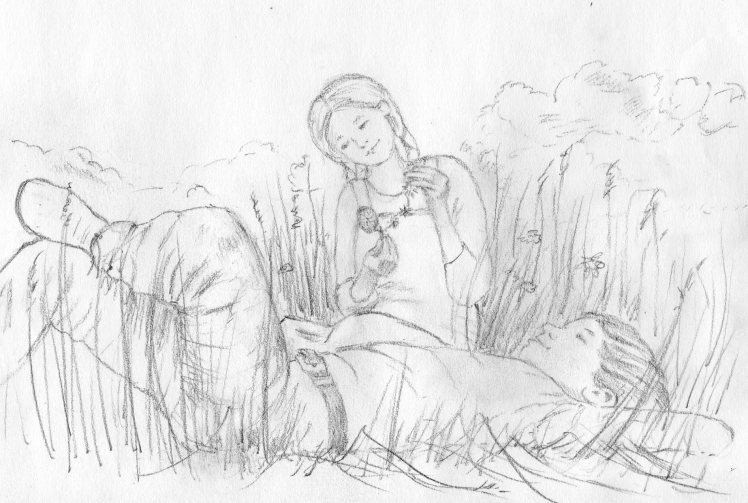
Helgi watched her thread a yellow poppy and an oxe-eye daisy onto the chain. She seemed absorbed in what she was doing but there was a tension in her silence. Suddenly, she said in a rather accusing tone:
‘You know, Helgi, you never really talk about your old life.’
Helgi gave her a startled glance. ‘It … it’s gone now. It’s all over,’ he said.
‘Gerda told me what happened. You chose to stay and fight, didn’t you?’ Embla said, looking up, her eyes shining with awe.
‘Mm.’ Helgi rolled over onto his stomach and let the meadow plants conceal him. He studied a brightly coloured moth crawling up the stalk of a tall buttercup.
‘It must have been terrible. Were you afraid?’
‘Not really. I was too busy.’
Embla laughed nervously, but Helgi hadn’t meant it as a joke. At the time, it had been a pure question of survival. It was only afterwards, when he replayed the dreadful events in his mind, that the full horror had hit him.
His guarded replies had aroused Embla’s curiosity. She had stopped threading flowers and was waiting for him to say more.
‘If you don’t want to talk about it, I understand,’ she murmured, as if she had guessed the subject was too painful for him.
‘It’s not that. It’s just that it’s a long story and I’d rather tell it some other time.’
Helgi could tell she was disappointed, but he didn’t like talking or even thinking about the circumstances of their exile much. He simply could not bring himself to tell her why he had chosen to stay and what had really happened. He would like to have told it the way she probably imagined it, as a tale of glorious deeds. He would like to have said that he rushed upon the enemy, slashing right and left with his scramasax, cracking helmets and splintering shields, but that would have been a lie. Not that he was ashamed of anything he’d done. But if he’d described how it really was, it wouldn’t have been what she was expecting to hear.
Embla held up the chain and examined it, then made a slit in the final stalk with her thumbnail and eased the first flowerhead through it, joining the ends to make a crown.
‘I wonder what Eric will do now he’s lost your uncle Arnor’s support? It must have been a big blow to him,’ she mused.
‘He deserved to lose it,’ Helgi said vehemently. ‘Eric’s a hopeless chieftain who doesn’t know how to keep his friends. He’s a thief. He harbours criminals! And when his sons go swaggering round the neighbourhood and lobbing axes at people just for fun, he does nothing to stop them.’
Helgi scowled to himself. His own father had been a good chieftain, not a petty tyrant. He had been exiled and lost everything because he had dared to protest against the abuse of power. He had been outlawed for trying to oppose powerful men who violated the law. Helgi felt a sudden rush of anger at the injustice of it all. He jumped up and grabbed Kol’s harness. Embla stood up too and brushed the grass off her skirt. She tickled the pony between the ears and solemnly crowned him with the chain of flowers. Kol tossed his head and snorted irritably.
Together, they wandered slowly down to the gate in the hayfield wall.
‘It’s little wonder Eric sees your father as a threat,’ she said. ‘If Arnor and Halfdan team up together …’
‘That’s not going to happen. Eric’s just a big fish in a very, very small pond,’ Helgi said loftily, knowing this would provoke a strong reaction from her. ‘My father couldn’t care less about him. He’s got bigger fish to fry back home …’ He grinned at his own joke.
Embla’s face clouded over. ‘I hope he isn’t hatching some crazy scheme to go back to Norway. It would be very dangerous—even suicidal—to oppose the king. There’s no dishonour in emigrating, you know. Think of all the brave people who came here to escape King Harald Fairhair’s tyranny in the old days. My great-grandparents, for example. You couldn’t call them cowards.’
‘Of course not,’ said Helgi. ‘They were pioneers.’ He smiled to himself—they’d had this argument before. Embla was very proud of the fact that her ancestors had been among the first settlers in Iceland and she seemed to take it as a personal insult that Halfdan didn’t want to stay in Iceland for good.
‘Their situation was just like yours. They were forced to leave because their lands had been seized by the king. But they managed to settle happily here and make new lives for themselves. What are you smirking about? What’s so wrong with that?’ she demanded indignantly.
‘Nothing—nothing’s wrong. You’re right—it’s history repeating itself. The only difference is that Harald Fairhair’s grandson is the one on the throne now. But even if it’s the same old problem, you can’t expect everyone to deal with it in the same way.’
They had reached the wall. Helgi swung the gate open and said, ‘I ought to go now …’
‘I just can’t understand why your father is so against settling here,’ Embla said plaintively.
‘Not everyone who left Norway in those days settled down. Quite a few of them took to piracy for a living. At least he isn’t thinking of doing that!’ joked Helgi.
‘As a long-term career, piracy has to beat feuding with the king,’ said Embla, with a dry look.
‘Well, there’s no point you or anyone else trying to talk him out of it. You know how strongly he feels …’
Embla nodded. ‘He’s obsessed. Stubborn. He won’t listen to reason.’
Helgi flew at once to his father’s defence.
‘It’s not that he’s stubborn or unreasonable! He was wronged and he wants justice!’ he cried, smacking his hand on the gate. He glared at Embla: she could be an insufferable prig sometimes—almost as bad as Malachi. ‘And I’ll tell you why arguing with him won’t make the slightest bit of difference. Because he’s fearless—the most fearless person I know. He isn’t afraid of anyone or anything—not even death itself!’ Helgi added, making a wild sweeping gesture with his arm.
This made Embla giggle and she imitated his sweeping gesture. ‘So what are you going to do about the Ericssons?’
Helgi set his mouth in a thin determined line. The Ericssons could go to the trolls for all he cared. If he had to rate the Ericssons on a scale of danger, they were nothing compared to the hazards he had outfaced in Norway. So why should he feel afraid?
‘I can look after myself,’ he replied, patting the little scabbard at his belt, where he kept his scramasax knife. Now that he was an outlaw, he sometimes liked to act the part.
Embla looked doubtful. ‘Don’t do anything stupid, Helgi.’
As Helgi led Kol through the gate, Audun came round the corner and sauntered across the yard towards them. He greeted them with his habitual ironic smile.
‘Hello Embla … Helgi.’ He looked at the panniers on Kol’s back in surprise and said, ‘You managed to get a pack-saddle on him!’
Helgi nodded, delighted that Audun had noticed and remarked on it.
Audun could not help being impressed. He remembered how earlier that summer, Arnor had told him to go and round up the ponies that were grazing in the mountain pastures because it looked as if a thunderstorm was approaching. ‘Oh, and take my little nephew along with you,’ he had added. ‘I think it would do him good—cheer him up a bit.’ Audun had dutifully gone round to collect Helgi, though the last thing he wanted was a twelve-year-old tagging along after him. He marched ahead up the hill and said very little to the boy who had to trot to keep up with him. He was in a bad mood because the rain was leaking into his boots and dripping off his hair into his eyes, and because he had better things to do than babysit a pampered brat who wouldn’t be used to hard work and would only get in his way.
The horses were grazing in an exposed spot on the lower slopes of Stapafell. Eleven of the twelve were huddled together with their heads down, steam rising from their backs in clouds and their sodden manes clinging to their necks. As Audun had expected, the black pony was standing apart from the others and nibbling the grass, quite untroubled by the wind and wet. He knew the black one would not want to come, because he was always so wild. Sure enough whenever Audun approached him, Kol shied away or tried to nip him and at last bolted off and stood watching him from a distance. ‘Up to his old tricks again!’ Audun exclaimed angrily. He went after the pony and made a grab at him but the wretched animal jerked out of reach, so Audun slipped in the mud and fell on his hands and knees. He picked himself up and wiped his muddy hands on his trousers, reluctant to chase the horse again and suffer any further indignity.
The boy was watching him shyly and biting his lip, as if he badly wanted to laugh or make a joke but did not dare. ‘Why don’t you catch him yourself, if you think you can do better!’ snapped Audun, glaring at him. Helgi’s eyes lit up, as if he had been waiting to be asked. He took one step forward but went no closer and gazed at the horse long and intently. His head was tilted inquiringly to one side. He stood quite still, never taking his eyes off the horse, his broad, rosy face expressive of a quiet confidence. The pony turned his head to look at him but remained anchored to the spot. Nothing could be heard but the patter of the falling rain and the muffled snorting of the other horses. Then Helgi turned away from the horse and looked off into the distance. Suddenly, the pony’s ears pricked up and he trotted over to Helgi and sniffed him with his nostrils. Helgi stroked his forehead, then embraced his neck and kissed him on the nose. After that, they had driven the herd back down the mountain through the rain and Kol had walked with Helgi back to the stable.
Looking at Kol now, standing in the bright sunshine with a pack-saddle on his back, Audun thought how remarkable it was that Kol would work with Helgi, but still would obey no one else. Helgi was a mere youngster, of course, and Audun would not ordinarily have taken much notice of him, but you had to respect a talent like that.
‘Where are you taking him?’ he asked Helgi.
‘Nowhere exciting. Just the dairy.’
‘I’m heading that way too. Got to see Alf.’
‘You can give Helgi some tips on self-defence on the way,’ said Embla, smirking at Audun.
Audun looked at her sharply, as if he suspected she was mocking him. ‘Always carry a big stick,’ he murmured. ‘Why, what’s up?’
‘Nothing I can’t handle,’ said Helgi, frowning at Embla.
‘He’s too proud to ask for help,’ she retorted. ‘I’m off now. You two should have plenty to talk about.’
She ran back to the house, but halfway there she looked back and called, ‘Take care, Helgi!’
Helgi barely glanced in her direction. Leading Kol by the halter, he headed up the path towards the mountain pastures with his new friend.
‘What was she on about?’ asked Audun.
‘Oh, nothing. Thorgrim Ericsson came looking for me earlier—that’s all. I don’t know what it was about.’
‘Nothing?’ Audun chuckled darkly. ‘You’d better go and find out what he wants. Once you’ve armed yourself with a big stick, of course.’
Helgi had no desire to appear flustered in front of Audun, a man who was not afraid to defy the Ericssons. ‘Thorgrim can wait till later,’ he answered coolly. ‘I don’t see why I should come running at his beck and call.’
Audun whistled in uneasy admiration. He had gone out of his way to avoid Thorgrim since nearly coming to blows with him a week ago. He still felt shaken by the encounter. He generally made an effort to stay on friendly terms with everyone, even people he disliked, so Thorgrim’s casual savagery had come as a shock to him. He thought he ought to warn Helgi about Thorgrim: Helgi was new to the area and perhaps he didn’t realize how dangerous their neighbour could be.
‘Fair enough,’ he said, ‘But if you leave it too long, it’ll look as if you’re deliberately avoiding him and he’ll have an excuse to punish you.’
‘Thorgrim doesn’t need an excuse to do that.’
‘True,’ Audun admitted, as they walked slowly along. He glanced at Helgi curiously, thinking it odd that someone so small should care so little about upsetting a vicious bully who lived right next door.
‘I can see why you resent him,’ said Audun, trying to figure Helgi out. ‘Thorgrim has no right to consider himself better than you. But he’s a good deal bigger, so you’d do well to exercise more caution.’
‘I never expected you, of all people, to tell me to grovel at his feet,’ Helgi remarked coldly.
‘I didn’t say that!’ Audun protested.
‘I’ve heard all about your quarrel with Thorgrim. You can’t expect me to bow down to him—not when you have so little respect for him yourself. Not when you treat him like a big joke.’
‘That filthy great axe he carries is no laughing matter,’ Audun replied grimly. ‘One of these days he might learn to throw straight.’
‘Thorgrim would do better with a spear—something he could throw from a safe distance,’ said Helgi, with a scornful laugh. ‘He goes around boasting about the great deed of valour he did when he threw his axe at you. But it never occurred to him to challenge you to a fair fight. That would’ve been the honourable thing to do.’
Audun frowned. ‘What makes you think I’d want to fight him?’ he asked.
‘You’re the kind of person who would, if you took him more seriously.’
Audun stiffened. It sounded like a challenge. You’d fight him if you took your reputation more seriously …
‘I’m not a violent man,’ he said, frowning at Helgi. He lowered his eyes and examined his scuffed and dusty boots as they trod the path. ‘I’d prefer to settle this peacefully. Arnor’s dealing with it. He’s got a responsibility to look after his workers. I expect he’ll have a word with Eric, and if that doesn’t do any good, he’ll bring a case against Thorgrim.’
Helgi knew for certain that his uncle had no such plans.
‘Thorgrim must think he’s going to get away with it,’ he told Audun. ‘Otherwise he wouldn’t have picked on you. He only picks on people he thinks haven’t got the power to fight back. He won’t be expecting any reprisals.’
They walked on a little way in a gloomy silence, Audun increasingly worried about what Helgi would say next. A fork in the path brought them to a shallow, stony stream, and they followed the trickling water up the valley. Suddenly Helgi’s face brightened, and he said, ‘It would be so easy to take Thorgrim by surprise! Lie in wait, and whack! Ambush him!’
‘Don’t be absurd,’ said Audun irritably. He was in no mood to humour Helgi. Cheeky little sod. Who did he think he was, trying to tell him what to do and provoke him into some stupid, desperate action?
Helgi gave a little shrug and said, ‘You’d be doing everyone a favour. You’re not the only one round here who has good reason to hate Thorgrim, but I can’t think of anyone else who’d have the guts and the inclination to do it.’
Audun came to an abrupt halt and boggled at him, as if they had reached the edge of a cliff and Helgi was telling him to jump. He could hardly believe his ears. Did Helgi really expect him to fight the son of a chieftain? It wouldn’t only mean taking Thorgrim on—there were also Thorgrim’s equally unpleasant brothers to think about, as well as a gang of brutal and heavily built fellows employed by Eric as bodyguards.
‘You,’ he said angrily, pointing a warning forefinger at Helgi, ‘are asking for trouble.’
Helgi laughed and pretended to whack at invisible enemies with an imaginary sword.
‘It’s not funny, Helgi. This isn’t just some childish dare!’ Audun hissed. He couldn’t decide whether Helgi was joking or serious.
Helgi stopped play-fighting at once, mortified that Audun had called him childish. ‘I thought you’d want to do something about it,’ he said sulkily, kicking at a stone in the path with his toe. ‘You and Thorgrim have got unfinished business. He tried to kill you! You can’t just leave things as they are.’
Audun stared at Helgi as if he were mad. Helgi gazed back at him, with a strange depth of light in his eyes. ‘You’re not afraid of him, are you?’ he asked, with a teasing smile.
‘Of course not!’ Audun snapped. He knew he could not turn down a challenge without incurring dishonour. He was trapped and it made him furious. He tried to think of a good, strong reprimand that would put Helgi in his place.
‘Listen, Helgi,’ he said, ‘what I choose to do about Thorgrim is my business. If you want mess with him, then fine. Go right ahead! You’ll get your head bashed in and …’
He paused. For some reason, he was finding it impossible to concentrate. Helgi was gazing at him quizzically with his head slightly tilted to one side. There was something oddly captivating about his eyes, a strange deep-blue luminosity. Audun had to force himself to look away.
‘And what’s more,’ he went on, with an effort, ‘you’ll find there aren’t many people round here who are prepared to help …’
Audun paused again. His thoughts kept slipping off track. He felt distracted as if something was tugging at him and niggling him. He felt incapable of raising an objection or, indeed, saying anything coherent at all.
‘…So,’ he continued, struggling to stick to the thread of his argument, ‘if Thorgrim gives you a hard time … which he probably will … just let me know.’
He caught his breath in astonishment. The words that had come out of his mouth were completely at odds with what he’d meant to say! He replayed them in his head, with a puzzled frown.
‘I knew you’d say that!’ Helgi exclaimed. He set off up the path, with a merry little skip. Audun suddenly felt happy and excited too: there was something infectious about Helgi’s childish delight. The rush of emotion caught him by surprise—he couldn’t quite make sense of it—but he didn’t examine it closely.
‘You don’t give a stuff about Thorgrim,’ said Helgi enthusiastically, as he bounded along the path. ‘You’re much too laid back to let him bother you. I think you’re the last person on earth who would grovel to him. I wish there were more people like you around here. Thorgrim wouldn’t get away his bullying if everyone stood up to him.’
Audun wondered whether Helgi was teasing him, but Helgi looked seriously impressed.
‘Perhaps I was a bit too laid back. I didn’t attempt to take him on at all,’ Audun said, with a note of regret.
‘But you defied him! Thorgrim threatened to kill you if he ever caught you talking to his cousin again, but that didn’t stop you going back. And you will take him on sooner or later. I know you will,’ said Helgi confidently.
Audun stared at him in bewilderment. Helgi’s belief in him was clearly based on some childish fantasy or bizarre misconception. At the same time, he found it deeply moving that Helgi considered him capable of performing such a feat. He suddenly conceived a warm, almost brotherly affection for him.
‘From now on, when it comes to dealing with Thorgrim, I’m going to follow your example!’ Helgi declared.
‘What? No! Don’t do that!’ gasped Audun, anxious to prevent another violent confrontation. ‘Look, if there’s been a misunderstanding, I’ll go round and talk to Solveig and she might be able to help.’
‘And risk your neck again?’ asked Helgi, wide-eyed with admiration.
‘Well, I’ll try not to lose my head, obviously,’ Audun joked, immediately regretting his impulsive offer. What on earth had made him volunteer to go back there? He didn’t want to go out of his way to antagonize Thorgrim any more than he already had. His mouth seemed to be acting independently of his brain!
‘It’s probably nothing,’ said Helgi. ‘Embla worries too much.’
Audun was glad to change the subject.
‘You’re lucky to have her as a friend.’
‘I suppose so, but she’s forever going on at me about what happened in Norway and what my father’s planning to do about it.’
‘Well, your father is a dangerous outlaw. Perhaps she finds him a bit scary. Or maybe the glamour of outlawry gives her a thrill,’ said Audun a little crossly. ‘Don’t ask me how women’s minds work.’
‘She just likes to argue,’ Helgi grumbled. ‘She always thinks she knows best.’
‘I thought you two were—you know—a couple.’
‘What? No!’ exclaimed Helgi, colouring a little. ‘She’s just a friend. I can hardly avoid her if she’s living at our house, can I?’
‘But you’re the one she hangs around with. What’s the secret?’
Helgi looked blank. ‘Secret?’
‘What does she see in you?’
‘I dunno! We argue most of the time. If it wasn’t for the fact that I test her medicines …’
‘You do what?’
‘Test her medicines. But I wouldn’t recommend it. She accidentally poisoned me the other day.’
‘That’s crazy!’ muttered Audun. ‘Nothing would induce me to do that!’
Over a rise in the ground, the little, low stone-built smithy came in sight on their side of the stream. A thin plume of smoke rose from the roofhole.
‘Good, he’s in,’ said Audun.
‘Is Alf making something for you?’
‘No, it’s a repair.’ Audun fished in his pocket and brought out a large whittling knife which had broken in half. ‘I was scraping the fat off a sheepskin and the blade snapped in two. It’s a disgusting job and I was hurrying it—serves me right, I suppose.’ He frowned at the pieces lying in his hand and heaved a troubled sigh. It was only a small misfortune but suddenly it loomed large in his mind and seemed to represent everything that was wrong in his life.
Helgi took the two halves from him and fitted them together.
‘I can think of a better use for this blade,’ he said quietly.
Audun felt himself grow tense. ‘What kind of use?’
‘A man who quarrels with his neighbour should never go out into the fields without a spear. Get Alf to make you one and stay on your guard all summer. You can’t be sure that you won’t need it.’
‘For protection,’ murmured Audun, glancing at him.
Helgi nodded and handed back the fragments without a word. Audun gazed at the shards of metal and saw them in a new light, as raw materials with a terrifying potential.
The broken knife was not an irritating nuisance after all. It was an opportunity to forge something brave and new.
Audun shivered, though he was not cold.
He wandered off the path and cut across the grass, not really thinking of anything. When he reached the flagstone by the smithy door, he remembered that Helgi was still there. He looked back over his shoulder as he pushed open the door.
‘See you later,’ said Helgi.
‘See you,’ Audun echoed. Then his face broke into a teasing smile and he simpered, in a little girl’s voice, ‘Take care, Helgi!’
‘Get lost, Audun!’
Chuckling, Audun ducked through the low doorway of the smithy. The interior was dingy and begrimed with smoke, but the fire of the forge glowed brightly, and lit up the tools scattered on the workbench and hanging on nails around the walls. Alf was standing at the anvil, tongs in one hand and heavy hammer in the other. He pulled a glowing lump of iron out of the fire and held it firmly on the anvil while he beat it with quick and steady strokes. He looked up for a moment to see who had come in, then resumed his noisy hammering. Sparks flew as he bashed the metal. He had stripped to the waist because the heat was intense and his upper body was covered with beads of sweat. He was wearing a filthy apron, his hands and arms were blackened with charcoal smuts, and the firelight gave him a savage appearance, accentuated by the grime on his face and his frowzy yellow hair. Audun waited until the hammer blows had stopped before he said anything.
‘Hey, Alf. Could this broken knife be made into a spearhead?’
Alf glanced at the pieces. ‘Yeah, a small one. Who’s payin’?’
‘The estate,’ said Audun firmly. ‘I have to be able to defend Arnor’s property and livestock when I’m out in the fields.’
Alf frowned and looked at him closely. ‘You expectin’ more trouble?’
‘It’s not just for my own protection,’ said Audun. ‘Anyone can borrow it.’
Alf gave a surly grunt in reply. Audun laid the pieces on the workbench and stood for a while watching him heat and hammer the horseshoe over and over again, admiring his skill. His own role on the farm required him to flit from one job to the next but if he’d had the time to master a craft properly he would have chosen metalwork; it was the most noble of all the crafts.
He told Alf he would be back in a couple of days to collect the spearhead. As he stepped outside the smithy he froze. Three figures were standing further up the rough path, with their backs to him, the tallest dressed in a long coat and a flat-brimmed hat.
Audun stood in the shelter of the low doorway, hidden by the thick turf walls on either side, and watched them for a while. A smile twitched at one corner of his mouth. Not so long ago he might have taken advantage of Thorgrim’s absence from home. If Solveig had wanted to see him, he would have gone over there right now …
Helgi’s question echoed in his head: You’re not afraid of him, are you? With a shock, Audun realized he was not.
If he’d had a brand-new spear in his hand, who knows what he might have done at that moment? Rushed upon his foe and struck him dead, and made short work of his brothers too! Audun felt a rush of satisfaction at the thought, but the glow faded almost at once. Whatever troublemakers like Helgi said, taking the life of another person would do nothing to restore his self-respect. It would be a vicious, futile gesture, like the reflex of a wounded, beaten animal who, backed into a corner, uses his last ounce of strength to lash out against his attackers. It would only make him feel worse.
No, he would not go looking for trouble, but he would be prepared for it when it came, as it undoubtedly would, sooner or later. And next time, he would not flee.
He slipped away and headed back down the path to the Manor.
 The Adventures of Helgi the Viking