Audun felt a bit sorry for the little Easterner who looked so lonely playing all by himself, but the next moment, as he walked out of the yard, he had forgotten him. Rejecting the path that led to the gate, he took a short cut between two low sheds and strode across the wet grass. He had to attend to some important personal business which could not wait.
He was on his way to Thorstead, the neighbouring estate that belonged to Eric, the local chieftain and father of Thorgrim, whose summons had struck such dread into Helgi. Like Helgi, Audun had always gone out of his way to avoid Thorgrim, as had most of the other boys in the neighbourhood. Thorgrim, the oldest and tallest of Eric’s three sons, was a year older than Audun; he was tall and lean with scanty, sandy-coloured hair, an ugly mouth, and a pockmarked forehead which he kept covered with a black, broad-brimmed hat. His brother Thorbrand, who was fifteen, was stockily built, with hard, close-set eyes and a thick mat of dark, curly hair, rooted almost as low as his eyebrows. Thorstein, who was younger by a year, had a squat and dull-witted look. Thorgrim boasted openly that though he was only seventeen, he had already killed three men in fights, and got away with it because he was Eric’s son.
Audun was not going there to pay a social call on Thorgrim and his brothers—he was, in fact, counting on them not being at home. The person he hoped to see was Solveig, Thorgrim’s beautiful cousin. Solveig was the youngest daughter of the leading chieftain in Breidafjord. She had been fostered by her uncle who had settled at Helgafell and whose son and heir was the most powerful man in the Thorsnes district, but she frequently came to stay with her uncle Eric, who had married one of her father’s sisters. Eric had inherited a share in a chieftaincy and his considerable wealth had enabled him to marry into this distinguished family.
The Ericssons took a very dim view of his interest in Solveig, and Audun knew that he was taking a risk if he ventured into their territory with the purpose of visiting her. He had called on her regularly throughout the summer, but only when he was fairly certain her cousins would not be there. But two weeks ago, he had made a miscalculation. Thorgrim had discovered them talking and laughing together over the gate. He had hustled Solveig back inside the house and told Audun to clear off back to his pigs if he valued his life. ‘I will not tolerate Arnor’s servants hanging around our gate!’ he had stormed, shaking his fist at him in a fit of savage fury. ‘I swear if I catch you pestering my cousin again, I’ll kill you!’
Audun had scuttled away and stayed quietly at home for several days after that. He had no wish to pick a fight with anyone, Thorgrim least of all. Audun had only been in two fights in his life, though he was proud to think he had won both of them. They had been scuffles really, not proper battles with weapons. Audun was cautious by nature. But his feelings for Solveig were such that he could not keep away for long, and Thorgrim’s prohibition only made him more desperate to see her.
He doubted too whether it had been a serious threat. Thorgrim had certainly looked angry, but Audun found it hard to believe that he really meant to kill him. Thorgrim was always threatening to kill people: he had threatened to kill someone the other day simply for blocking the road with a slow-moving wagon. In any case, Thorgrim had no grounds for putting him to death: he had done nothing wrong. He and Solveig had simply been enjoying a friendly chat. The chances were that if the Ericssons caught him hanging about, they would beat him up, nothing more. And what were a few bruises and a split lip, compared to the pain of never seeing her again? Audun was prepared to risk a beating for her sake, but he would take care not to be seen.
So he timed this visit carefully. He had found out from Malachi, who knew all the local gossip, that Thorgrim and his brothers were going to Budir that day to sell a horse, so would not be at home. Budir lay several miles away up the coastal path so they were unlikely to return before late afternoon.
Eric’s residence lay within walking distance, but Audun took the precaution of bringing a horse, in case he needed to make a quick getaway. He was safe if he kept to the coastal path which ran past Eric’s estate, but the entrance to the farm lay some distance from the main thoroughfare, so he couldn’t exactly pretend he had just happened to be passing. He would just have to hope that the brothers didn’t come home early.
The way out of the valley crossed a ridgy bank of lava over half a mile wide. The path across the lava was sometimes rocky and sometimes spongy underfoot: the stones, where naked, were broken and crushed by the passage of men and horses, but carpeted in places with springy grey-green moss. Heather and bilberries and tiny weeds grew in the cracks between the rocks. Audun dismounted here and led the pony over the treacherous terrain. The lava terminated when they came to the end of Stapafell. Before him lay another valley which ran down to the gently curving bay. In the middle of this wide, flat plain which divided a long range of shadowy mountains from the sea, stood an imposing house surrounded by smaller outbuildings and a hay meadow ringed by a stone wall. This was Eric’s estate, Thorstead. The whole valley belonged to him, and part of the next valley along (much to Eric’s chagrin, his lands were divided by a mile of lava). A swift clear stream curved around the meadow in which the houses stood. Beyond the stream the ground rose in a broad grassy bank where sheep grazed, and behind this hill the steep sides of Stapafell and a fragment of the white head of Snaefell were visible.
Audun rode cautiously down into the grassy valley, his eyes scanning the estate for signs of enemy movement. He was more than a little nervous now that he had left the path.
When he reached the farmstead, he lingered by the main entrance, not daring to set foot inside the five-barred gate. Eric might still be around, even if his sons weren’t at home. The air was warm and still; the yard and hay-meadow utterly deserted—the only sign of movement was a trickle of smoke rising from the farmhouse roof and the swishing of the horse’s tail as it swatted away the flies. Somewhere on the estate, a dog barked. Audun leant against the wall and waited, casting occasional nervous glances across the valley towards the higher ground where the path that led to Budir ran near the cliff-edge. There was no knowing when Thorgrim and his brothers might return.
Audun noticed his hands were grimy. He should have washed them in the water trough, but it had slipped his mind because he’d been in such a hurry. He tugged his fingers through his tangled curls and wiped his face on his sleeve. He touched the soft down on his upper lip a little self-consciously. Solveig said that whiskers didn’t suit him because they made him look older and more serious than he really was, but she also joked that her cousin Thorgrim couldn’t grow a beard at all, so Audun couldn’t be sure what her views were on the subject. But she couldn’t expect him to shave it off. Almost all the men he knew had beards and moustaches, combed and plaited in interesting styles.
Time crawled by. As Audun waited, he began to yield to a drowsy, mid-afternoon feeling. Tired of standing, he slid his back down the gate post and came to rest at its base. He sat leaning against it with his knees drawn up, scratching swirly furrows in the loose dirt with a stick, and yawning in the warmth of the sun. His eyes started up every now and then whenever he thought he detected a movement on the path, but though his body stayed alert, his mind was not sufficiently interested in the Ericssons and constantly reverted to Solveig. He could not keep his attention from straying. He stared at the path with fixed but unseeing eyes, wholly preoccupied by the amorous fantasies which rolled lazily through his head.
He had lost all consciousness of time, when a sharp sound, the click of a latch in the yard, startled him and he jumped to his feet, hastily dusting down the seat of his trousers. The farmhouse door opened and Eric’s old washerwoman came staggering out with a heavy basket on her arm. She was on her way to the stream to wash the bedlinen.
‘You don’t give up easily, do you?’ she said with a delighted cackle, when she saw Audun waiting by the gate. She put the basket down and bustled back inside the farmhouse to tell Solveig he was there.
Audun watched the door, willing it to open. He did not know how long he had already been waiting, but the sun was now well past the mid-afternoon mark and the shadows were lengthening. Solveig always kept him waiting and sometimes she did not come out at all. Audun knew she was tormenting him, but he put up with it. He came from a poor family, he was a hired farmhand who owned no property, and he had no inheritance to speak of so could not expect any great improvement in his position in the future. This had never mattered to him up till now, but he knew it was a cause of embarrassment to Solveig, and he always went there with low hopes.
It had started almost by accident a couple of summers ago, when he was horsing about in the fields with one of his friends, and pitched a load of hay over his head, and Solveig, who was sitting nearby with her friends, had laughed. It had taken him almost a year after that to pluck up the courage to speak to her. She seemed to like it when he teased her and clowned about, but she never took him very seriously, and Audun was afraid to be too serious with her in case it scared her off.
Audun paced up and down. He would not feel at peace until he had at least seen her, but it was risky to hang around much longer. He stood there irresolutely, looking towards the hill over which he had ridden, and tossing the bridle in his hand. If she came out and found him gone, what would she think? He decided to count to one hundred five times, and then go. Every time he reached a hundred, he folded down a finger on his right hand. Then he did the same on the left hand. Eventually, he ran out of fingers. He was on the point of walking away when suddenly there she was, standing inside the gate.
She had come to him silently, like a radiant being from some infinitely remote, higher sphere. The sight of her gave his heart a painful jolt. Her long white apron was pinned at her shoulders with silver brooches, her hair tightly coiled around her head in a silver crown, and she seemed to shed a silvery light on everything around her. As Audun gazed at her, entranced, a feeling of such tenderness arose in him that he unconsciously began to smile. Solveig did not look nearly as pleased to see him.
‘It’s very incautious of you to keep coming here,’ she said sternly. Her voice was silver too, polished and refined.
‘But I like hanging around here—it’s my favourite spot,’ said Audun. ‘There’s a lovely view of the bay, and Eric’s farmyard …’
Solveig smiled at him. ‘Please, Audun, you must go! It’s not safe.’
‘All right, I’m going! I’ve seen everything I came to see now.’
He walked off towards the hill, then stopped.
‘Oops. Forgot my horse,’ he said, coming back again. He strolled over to the gate and leant on it.
‘You could invite me in,’ he suggested in a bold whisper. ‘Then we wouldn’t have to talk out here in the open where everyone can see.’ He glanced over his shoulder towards the hill on the further side of the valley, which was completely deserted.
Solveig looked scandalized. ‘I can’t do that—my uncle wouldn’t approve!’
‘Please, Solveig! I only want to talk.’
Solveig gave him a long doubtful look.
‘All right,’ she said reluctantly, ‘but you mustn’t stay long.’
Audun could hardly believe his luck. He hadn’t expected this—she had never agreed to let him in before!
No one was about so she opened the gate. A pang of fear at the thought of crossing Eric’s boundary held Audun back for an instant, but then he figured he might as well be hung for a sheep as for a lamb. He led the horse inside and waited on the muddy track while she closed the gate behind them. Solveig threw him a furtive glance, which Audun took to mean that he should follow her. They walked across the grass towards a secluded outbuilding that faced away from the farmhouse. There was some timber stacked in a low pile against the front wall and she seated herself on top. Audun looped the horse’s halter around a ring in the door. The door was slightly ajar; it was dark inside and the warm sweet scent of hay wafted through the opening. Audun’s heart began to thump as he became conscious of hitherto unimaginable possibilities. He straightened up, almost too afraid to look at Solveig, and went over to the logpile, where he stood to one side, in the strip of shade cast by the wall, feeling awkward, too tall to look her in the face, but not worthy to sit beside her like an equal. He tried to think of something nice to say, but he wasn’t very good at compliments.
‘You look very beautiful today, Solveig. When I saw you by the gate just now, I mistook you for a goddess.’
He took up a casual position, leaning his shoulder and then his head against the turf wall, but regretted it as he felt the cold and damp seep through to his skin.
Solveig’s mouth twitched with irritation, as if she was heartily sick of being told how beautiful she was.
‘Sometimes I wish I were invisible,’ she said in a sad, grave voice.
‘Invisible? Why?’
‘Because if I were a nobody, I’d have more fun. I could do what I wanted and I wouldn’t be so bored.’
‘Surely a chieftain’s daughter can do what she likes.’
Solveig shook her silver head. ‘They never let me do anything.’
Audun pushed himself away from the wall. He began to feel very excited. Not only was Solveig unhappy with her life, but she had chosen to confide in him! He wondered what it was that she secretly desired to do. He sat down beside her on the woodpile, realizing too late that he had forgotten to ask her permission, but Solveig appeared not to have noticed, or at least did not object.
‘A chieftain’s daughter should be bold and fearless,’ he said encouragingly, ‘and not be afraid to follow her heart.’
‘What if no good could come of it?’ asked Solveig. The faintest glimmer of a smile played about her mouth. She would not look at him.
‘No good? Solveig, don’t tell me that you want to commit a crime! Or that you’re planning to run away to sea—or join a group of travelling minstrels.’
‘No!’ she said, breaking into giggles.
‘What is it you want to do?’ asked Audun, unable to contain his curiosity any longer.
‘I can’t tell you that!’
‘Why not?’
Solveig sat looking straight in front of her, with her hands folded in her lap, smiling to herself and saying nothing.
‘If all you want to do is make yourself invisible, that’s easy. We could go inside the haybarn and sit in the darkest corner and …’
‘Audun!’ Solveig gasped, deeply shocked.
‘… and continue our talk there,’ he finished, with a look of wide-eyed innocence.
‘And what if Thorgrim comes back and overhears us? You know what he threatened to do to you if he ever found you here again.’
Audun darted an involuntary glance towards the gate, his nerves suddenly taut. He watched a crow alight on the topmost bar and take off again.
‘He’s a strange fellow, your cousin,’ he said, prising a loose splinter from the log on which he sat, and flicking it away. ‘He doesn’t go out of his way to make visitors feel welcome. Still, I suppose having him around saves Eric the expense of keeping another guard-dog.’
‘Thorgrim has a loud bark but he means well,’ said Solveig. ‘He only wants to protect me, but he can be a bit frightening at times.’
Turning to look at her directly, Audun asked, ‘Does he threaten you, Solveig?’
‘No, not exactly. Not me personally.’ The corner of her mouth curled playfully. ‘Why, what would you do about it if he did?’
‘Whatever you want me to do. I’m yours to command,’ Audun said, bowing a little at the waist, after a moment’s nervous hesitation.
‘A safe answer, and a pretty one,’ said Solveig mockingly, though she looked pleased with him. ‘But this is a safe and pretty place compared to where I come from. Things haven’t been too peaceful at Helgafell since the death of my cousin last year. They’re intent on hunting down the killer. They talk about nothing else! Always boasting about what they will do to the outlaw once they run him down. When I’m there, I long to get away—but when I get here I find my brainless cousins make equally dull company.’
She gave Audun a forlorn smile that made him want, more than anything, to take her in his arms and comfort her, and prove to her that he was not as dull as most other men. He moved a little closer and slipped his hand tentatively into hers. Solveig’s gaze rested for a moment on their hands, then darted up at him. Audun looked inquiringly into her wide, bright eyes. It was impossible to tell what she was thinking. Her expression was nervous—or excited, he couldn’t tell, but she had made no protest when he took her hand and he wasn’t going to let this opportunity slip. He leant close and brushed her cheek with his lips.
‘You’d better go,’ murmured Solveig, turning away and looking very tense. ‘Thorgrim could be back at any moment.’
‘I don’t care about him,’ said Audun. He was conscious only of her beauty: her sparkling eyes, the delicate blush on her cheeks, her thin, slender hand still in his.
‘Please, Audun.’ Solveig pulled her hand away and stood up, suddenly cold and distant. ‘Go now, and don’t come over any more.’
She turned away and started walking swiftly back to the house. Audun sat frozen to his seat, a lump of dread solidifying in his chest. How could he have been so stupid? But it had been such a small thing! A peck—barely a kiss at all! He jumped up and hurried after her.
‘Leave me alone,’ muttered Solveig. ‘I can’t speak to you again.’
‘Why?’ Audun demanded, looking injured, as if he wasn’t aware that he’d done anything especially wrong.
Solveig stopped and turned to him with an impatient sigh, as if she could not understand how anyone could be so obtuse. ‘If you must know,’ she said quietly, ‘it’s got nothing to do with Thorgrim or my uncle or anyone else.’ She lowered her eyes. ‘It was wrong of me to have anything to do with you in the first place. I’m sorry if I’ve given you false hopes …’
Audun felt his face flush with shame and anger. He had never entertained foolish hopes as far as Solveig was concerned. He was under no illusions that anything he had to offer her could make up for his woeful lack of money.
‘You haven’t done anything wrong, Solveig—I’m the one who should apologise,’ he said. ‘I went too far just now and I’m sorry. I never meant to be disrespectful. Please forgive me. Don’t banish me forever,’ he added with a short abrupt laugh.
Solveig said nothing and kept her eyes glued to the ground.
‘I was an idiot just now,’ he went on. ‘You let me inside the gate and I should never have hoped for anything more. Perhaps I do deserve to be turned away … But I never meant to offend you. All I want to do is make you happy. Just tell me what you want me to do and I’ll do it. I’ll do anything for you!’
Solveig remained obstinately silent, and seemed to be willing him to go away. Pleading and begging were not going to get him anywhere, and Audun was suddenly sick of humbling himself for nothing. It would be better to make a dignified retreat.
‘You want me to go. All right then, I’ll go … if that’s what you want.’
Solveig gave him an anguished glance. She looked miserable as well as embarrassed. Audun hated himself for making her so unhappy. Why had he ever gone to see her? Why did he feel it so necessary to trouble her? Just out of a selfish need to relieve his own suffering. Suddenly he was desperate to leave. He bowed to her without another word and went back to the haybarn to collect his horse.
A moment later he was back again with his horse—he couldn’t bear to go without knowing the truth.
‘Solveig, it’ll be years before I can support a wife and family and I don’t suppose I’ll ever be in a position to—to ask you …’ He broke off. ‘But suppose I was a chieftain, or a wealthy landowner. Would that make a difference to the way you feel?’
He waited earnestly for her answer. Solveig gave him a pitying smile and shook her head in exasperation. She was about to say something when her eyes suddenly grew wide and she let out a frightened squeak, grabbed her skirts, and fled back to the farmhouse.
Audun started round and saw the farm gate swing outwards. A manservant was holding it open. Thorgrim rode through, flanked by his brothers who were also on horseback. His eyes were obscured by the broad brim of his hat, but Audun could tell that he wasn’t pleased to see him because his mouth was contorted in an ugly snarl. Thorgrim said nothing at all, but reached for something hidden inside his cloak. Audun didn’t wait to find out what it was. His means of escape was standing right next to him. Without a moment’s delay, he stuck his foot in the stirrup, swung himself up onto his horse’s back, spurred furiously, and galloped off up the track towards the farm buildings. The brothers thundered after him in hot pursuit.
The courtyard was the last place Audun wanted to go, but the Ericssons were blocking the gateway so he had no choice. He cantered into the yard, scattering chickens, and looking frantically round for an escape route. The clatter of hooves behind him made him glance over his shoulder and he saw the brothers enter the yard. Thorgrim was swinging a heavy, long-handled axe in his right hand. Audun recognized the weapon at once: Thorgrim called it Ogress and carried it with him everywhere, in a sling concealed beneath his cloak. The axe-blade was ornamented with long silver snakes whose tails twined towards the handle and whose tongues were said to have tasted the lifeblood of three men.
Audun pulled on the right rein and steered the horse between two outbuildings. They galloped towards Eric’s sheep pasture and ran down into the stream, the pony’s hooves slithering on the slippery bank and the stony riverbed. On the other side, they sank into a mire. Audun gripped the pony’s flanks with his knees to steady himself as they plunged sideways. The horse scrabbled with his front hooves, desperate to free himself from the bright green mud that sucked at his ankles. Audun urged him on, in a fever of anxiety, and at last he caught a firmer ledge by his fore-feet and scrambled out onto higher ground and they were able to gather speed. They climbed the low hill and galloped along the top, scattering the terrified sheep that stood in their path. The bank ended in a steep drop and Audun realized, to his dismay, that the only possible way down would bring him back to the farm. Thorgrim had just crossed the stream, ahead of the others. Audun retraced his steps and forced himself to delay until Thorgrim’s horse had reached the top of the hill and was running towards him. Then down they went, Audun bracing his thighs to stop himself toppling forward and the horse sliding on his haunches, unable to gain a firm hold on the muddy bank.
At the bottom, they crossed the stream again and headed directly towards a low stone wall. Audun bit his lip nervously as the barrier loomed before him; he had never jumped a wall on horseback before and he wasn’t sure the pony would manage it. He crouched low over the horse’s neck and gripped the reins, as he felt the horse gather himself and leap. The horse cleared the wall in a bound and bolted off across Eric’s hayfield with Audun hanging on for dear life. The Ericssons’ horses vaulted the wall and tore after him, their riders yelling hideous war-cries.
Audun cursed, deeply horrified to find himself trespassing within the hallowed precincts of Eric’s hay meadow. He was going much too fast. The tall summer grass tangled around the pony’s hooves, and as he ran he plunged and stumbled over curious undulations in the ground. The surface of the meadow resembled a series of closely packed mounds, uncomfortable to ride on and almost impossible to cross at high speed. It was entirely possible that the animal would break his leg on the uneven ground and that Audun would fall and break his neck. Luckily for him, his pursuers were forced to slow down too, and Audun was just beginning to think he might get away when he heard a furious barking. Glancing behind him, he saw that the Ericssons had been joined by reinforcements: a number of large fierce dogs—six, or maybe more—were bounding through the grass towards him, incensed that any pony should dare to set foot in their master’s hayfield.
They struggled on over the hummocks, with the dogs baying and snapping at their heels, until they reached the stone wall on the far side and the horse leapt again. Audun was clear of the farm now, and the dogs stopped at the wall, barking wildly as he sped away, but the Ericssons still gave chase. He heard the beat of galloping hooves behind him and leaned forward over the horse’s neck, digging in his heels and urging his mount to go even faster. The horse responded and flew across the valley like the wind.
Almost immediately, the ground began to rise. Audun drove the animal up the slope, his mind racing ahead of him to the troublesome stretch of lava that he knew he would have to negotiate—another obstacle that would be foolhardy to cross at high speed.
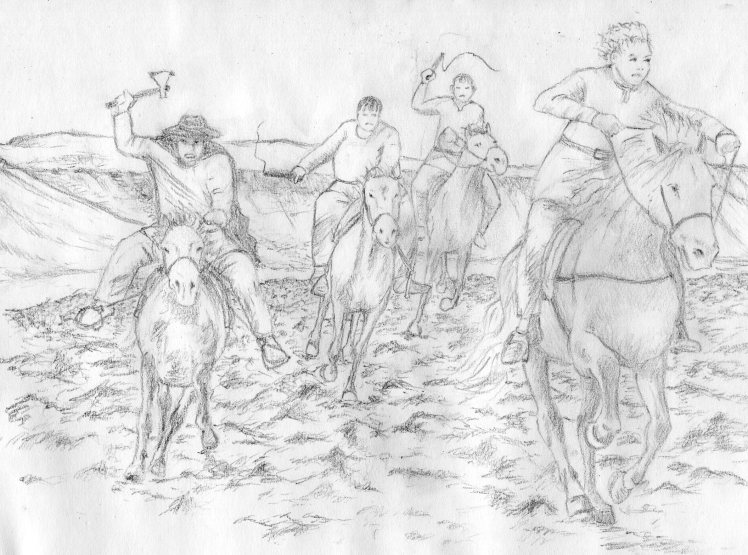
Audun came to the brow of the hill and entered the lava field. They trotted swiftly over rubble, treacherous craters and holes and strange-looking bumps and ridges, some black and broken and lethal as smashed glass, others grown over with herbs and moss. The horse was nervous of the terrain and Audun had to flap his legs against his sides to keep him moving. He flashed a backward look and saw that the gap had narrowed as the Ericssons thrashed their ponies, driving them on at a reckless pace over the jagged rocks and broken stones.
They emerged from the lava onto a smooth grassy slope and the horse’s gait changed to a gallop which grew swifter and swifter as they descended into the valley. The Ericssons put on a burst of speed too. Glancing back, he saw they were very close now—within a few seconds of overtaking him. But Arnor’s farm was now in sight; if only he could reach it he would be safe. Audun crouched over his horse and urged it on. Not much further; the perimeter wall was looming close. The horse took the jump at full gallop and landed well past the boundary on the other side.
Thorgrim’s horse came to the wall and shied away. With a bellow of rage, he wheeled the animal about and tried again, but the horse still refused to jump, so Thorgrim stood up in the stirrups and hurled the axe after Audun. It was a powerful throw, and well-timed—Audun felt a gust of wind as the weapon whistled past, narrowly missing his head. The axehead struck the ground just in front of them. The startled horse reared up, neighing and clawing the air in terror, and backed away several feet. Audun was almost thrown to the ground. He clutched at the animal’s neck and fought to stay in the saddle. Then the front hooves crashed down, and horse and rider bolted away, dangerously out of control but beyond reach of the Ericssons.
Safely back in Arnor’s yard, Audun congratulated himself on his narrow escape. But in the week that followed, he increasingly began to wish that he had stood his ground and fought, instead of running for his life. There was nothing he could do now. It wasn’t that paying Thorgrim back was inherently difficult, or that he cared much about the consequences for himself (his life was over now that Solveig had rejected him), or that he thought the Ericssons deserved to live. It was simply that he could not maintain a black and vengeful mood for very long. He could not feel angry enough with Thorgrim to do anything about it. Thorgrim was Solveig’s cousin: he could not hurt him without hurting her. Thorgrim saw it as his duty to protect his cousin from the unwelcome attentions of a farmhand, and Audun supposed that was reasonable, even if the attempt on his life was not.
‘I hate my life,’ he thought, as he lay awake at night, staring into the darkness of the roof above him and listening to the patter of the rain and the soft snores of his neighbours on the sleeping-bench. ‘And I’m not satisfied with myself. It’s hardly surprising that Solveig doesn’t take me seriously when I don’t even respect myself.’
Audun felt as if he was stifling and could not breathe. He turned over, wishing he could escape his misery and drift off into unconsciousness. He wondered what to make of the pitying smile Solveig had given him just before their conversation had been cut short by Thorgrim’s return. She regarded him as a joke—that much was obvious—but the more he thought about it, the less certain he was that her rejection of him had been final.
He had gone over a week without speaking to her now! He didn’t dare approach her, though he looked out for her all the time and once, when he had to go over to Eric’s to return a stray sheep, he caught a glimpse of her in the yard. Seeing her was like a stab to the heart, but on days when he did not see her he felt restless and tormented. He could not concentrate on his work, felt no interest in the conversation which went on around him at mealtimes, and had no appetite. More than once he found himself thinking he would rather be dead than have to go on like this for the rest of his life. Years and years of dreary loneliness stretched ahead of him.
 The Adventures of Helgi the Viking