Helgi stood up on the water trough and walked all the way round it until he reached the other side of Kol. He stood there for a while, balancing on first on one leg, then on the other. His gaze moved beyond the low grassy longhouses and the hay meadow to the treeless sloping pasture beyond, which led boldly away from the farmstead up towards the foot of the mountain, where the sheep grazed. It climbed higher and higher, following the steeply rising contours of Stapafell. Stapafell was crowned with fantastical pinnacles, but was dwarfed by his big brother Snaefell, to whom he was joined by the lower neck. Snaefell, the brooding triple-peaked volcano that sat at his back, reached higher still.
Helgi’s uncle liked to joke that in his formative years, Snaefell had led a wild and riotous life, but his youthful excesses had worn him out, and these days he was a slumbering giant who wore a gleaming white night-cap even in summer. On this particular day, his ancient, snow-white head was shrouded in cloud.
The phantasmal merging of land and sky transported Helgi back to the snowy mountainous country they had left behind in Norway. Suddenly his heart was full of the thought of his old home and his eyes filled with tears. The hazy mountain top dissolved as his vision blurred and cleared again.
For a moment he thought he could hear the cold waves lapping on the shore of the blustery island where his father’s great estate had stood at Borg, up in Halogaland, in the far north of Norway. He remembered the pine logs crackling in the hearth in the middle of the banqueting hall; the smoke dancing among the rafters where preserved fish, slabs of meat, and dried herbs hung; the scrubbed birchwood tables and long benches, and above each place on the bench a shield and a spear hanging on the panelled wall.
Two pairs of huge wooden pillars had supported the roof-structure of the hall, both elaborately carved from the top to the base with twisting branches, vines, and roots. Amongst the foliage dwelt birds and small beasts with fierce gaping mouths and gripping talons. As a small child, he liked to lie on the floor of the hall, gazing up either of these massive trunks, and imagine himself climbing through the coiling branches and befriending the wild creatures that hid there. There were other beautiful wood-carvings too, on the posts that stood on either side of his father’s high seat—the famed warrior Sigurd killing the dragon, the smith Volund and his bride Hervor, the swan maiden, flying with feathered wings outspread, the god Thor striking down a hideous-looking giant with his massive hammer. He knew and loved all the stories behind those pictures: Gerda often used to tell them to him after supper, when they were sitting in the hall.
Little details he had observed as a small child came flooding back to him with peculiar clarity: the particular pattern of knots in the grainy floorboards, the rocky crevice on the shore where tiny wild cranberries nestled in the summer; the warm furry smell of the reindeer calf he had helped to raise by hand, the sawdust and wood-tar smell of the two spacious boathouses where his father kept his ships. The old shed, which was empty for much of the year, was home to Halfdan’s cargo ship, the Swan, and the new shed had been built to house his magnificent longship, the Midgard Serpent. A cluster of smaller boathouses for the fishing fleet stood beside them on the western bank of a sheltered inlet, facing a jagged wall of grey-green mountains on the opposite shore. On the same strip of beach was the little jetty where Helgi used to moor his rowing boat …
Helgi felt a sweet and pleasurable pain as he dwelt on these memories. Since their exile from Norway, he had made a big effort not to think about his old life, and yet today something—he didn’t know what—had raked through the ashes and disturbed melancholy thoughts. They smouldered like live coals and made his chest ache with longing.
He buried his face in Kol’s sun-warmed mane and breathed in the warm, musky smell, and felt Kol’s strength and calmness passing into him. He wiped his eyes and felt better.
His father had been a prosperous chieftain in those days, with a large household to support. He had at least forty men in his service, who went fishing for cod and herring and caught seals, and kept the estate well supplied with food. The men who had families lived in four small houses, known as the barracks, which stood in a semicircle between the main residence and the smithy. Those who did not go fishing grew barley and looked after the livestock on the estate.
Halfdan kept not only sheep, horses, and cattle, but a herd of around two hundred semi-domesticated reindeer, which was tended by a Finnish reindeer herder called Aslak, an elderly man with keen eyes and a face as wizened as a walnut. In late spring, Halfdan and Aslak sometimes went on hunting trips in the mountains on the mainland, and on one occasion, when Helgi was about four years old, his father found a tiny wild reindeer calf with a pure white coat. Its mother had been trapped in a pit and killed, but Aslak persuaded Halfdan to adopt the calf because having a white reindeer in the herd would bring good fortune.
Helgi remembered them bringing the calf home. He begged his father to give him the job of looking after it, and Halfdan agreed, on condition that he listened to the herder and followed his expert advice.
The little orphan was very shy. His large dark eyes were fringed with silver lashes, his wobbly legs looked like chair spindles, and two fuzzy lumps were already prominent on his brow where his antlers would sprout. He grew quickly and developed a voracious appetite. Helgi spent many hours pampering him, gathering cloudberries for him as a treat, and watching the little reindeer greedily devour the golden, honey-flavoured fruit.
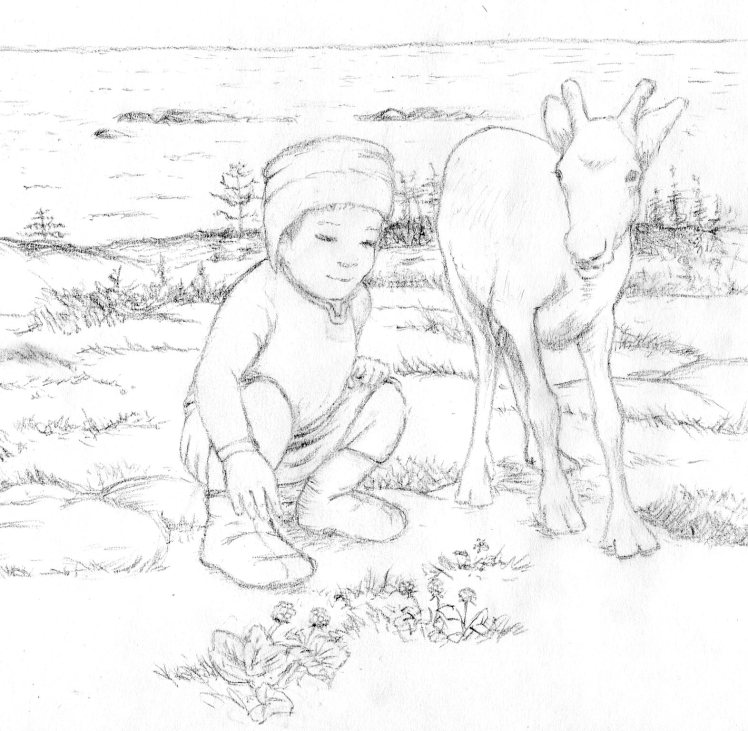
‘I’m going to call you Luomi,’ Helgi told him one day, as he fondled the calf’s snow-white velvet ears. ‘That’s Aslak’s word for cloudberry. He’s teaching me his language, but don’t tell anyone, it’s a secret!’
The presence of a lucky reindeer in the herd was not enough in itself to ensure Aslak’s success as a herder. It was important to honour Luomi. Aslak insisted that Luomi should be treated like royalty. He was allowed to forage in the best pasture and was kept in special quarters, separate from the rest of the herd that grazed and wandered in the paddock. On special occasions, Aslak’s wife plaited Luomi’s tail and festooned his neck and antlers with garlands, and when his first antlers were shed the following year, Aslak placed them on a rock down by the shore as a midsummer sacrifice. Luomi promised to be one of the strongest and fittest animals in the herd once fully grown, so when Aslak said he should not be expected to carry heavy loads and draw sledges like an ordinary beast of burden, Halfdan’s patience finally snapped.
‘You treat that animal like a spoiled child! He ought to pull his weight with the rest of the team,’ he grumbled.
Aslak was horrified. ‘Luomi is sacred! The prosperity of the herd is depending on him. I can’t continue to work here unless he’s treated with respect.’
Halfdan couldn’t afford to lose Aslak’s expertise, so he had to back down, and Luomi retained his privileges.
Luomi’s wild streak had never been broken by hard work. But because of the risk of losing him, he was not accorded the kind of respect shown to a wild animal. He was hobbled with a board round the ankle or neck to prevent him from running away when the snow thawed or when he was bitten by mosquitoes. The weight of the hobble made him bad-tempered and Helgi knew he hated it. The bigger he grew, the more aggressive he became. He fought any reindeer who strayed into his patch, and even Aslak found him unmanageable. Aslak joked that little Helgi was the only one in the household who could handle the brute. It was true that his presence had a tranquilizing effect on Luomi. If Helgi removed the hobble when the adults weren’t about, Luomi would never wander far from his side.
Helgi was playing with Luomi in the corral one day, when his father came down to talk to Aslak. Halfdan halted by the fence and stared in disbelief as the reindeer suddenly stood up on his hind legs and danced in a circle. The reindeer lowered his front hooves to the ground and stood watching Helgi. Helgi kept him waiting and would not meet his eye. Then, suddenly Helgi whirled around on the spot, and the reindeer stood up and pirouetted again, mimicking him. Laughing, Helgi threw a ball and Luomi caught it on his antlers and playfully tossed it back. Aslak cheered and clapped, but Halfdan’s face grew dark and troubled. He turned to Aslak and said that such behaviour was unnatural in a reindeer. ‘Luomi is behaving like an animal possessed,’ he said, ‘and anyone other than a Finn would have had the sense to put him straight back in the forest long ago.’ Aslak replied that the boy was lucky to have been born with a talent that most herders would envy and that even though Helgi was only six, his ability to tame recalcitrant beasts was already proving useful on the estate. Halfdan said, ‘That may be so, but it ill becomes the son of a chieftain to fritter away his time performing silly party tricks, like a common fool. We’ll have no more of this nonsense in the future.’
His father’s words rankled with him even now. Helgi was rather proud of his uncanny rapport with difficult animals. He ruffled Kol’s forelock sadly. Kol more than made up for the loss of Luomi, but he could not help missing his old friend.
He remembered how every autumn in Norway it had been Halfdan’s custom to sacrifice a large number of the reindeer to the gods for good luck before he and his men set out on their journey east to obtain goods from the Finns and to explore the mountains. Most of the meat was eaten at the farewell feast. His hall was packed with guests: all the men who were coming with him on the expedition were invited, as well as his family, friends, neighbours, and allies. Halfdan’s parties were renowned for their extravagance—they lasted a full week and no expense was spared.
Helgi counted back four feasts. He must have been nine when he was allowed to stay up late for the feast for the first time. The hall was decorated for the occasion with fine wall-hangings and garlands of foliage. The flickering light from the oil-lamps mounted on the walls and the open hearth where the meat crackled and smoked, filling the room with its rich brown aroma, lit up the faces of the company as they laughed and talked. It glinted on the bronze pitchers and the expensive Rhenish glass goblets, decorated with gold leaf, which Halfdan had acquired on one of his trading journeys. Helgi had felt very grown up, sitting beside his father’s high seat and being introduced to the guest of honour, Sigurd, the Earl of Hladir—a stout, jovial man with a long, white, square-cut beard. Helgi’s father and Earl Sigurd were close friends, and although the earl was the most powerful man in Trondheim and the north, he wasn’t too serious and self-important to ignore children. He teased Helgi as if he were a favourite nephew and let him try on his helmet. It was much too big for him and everyone laughed when it slipped down over his eyes. Helgi smiled, remembering how he had loved being the centre of attention. He’d had a soft spot for the earl after that.
The earl had stood up, straightened the helmet on Helgi’s head, and raised a toast to the success of Halfdan’s trading mission.
‘Here’s to a profitable journey! May the Finns hand over a generous amount of tribute this year! Then you’ll be able to afford many more magnificent feasts like this one, Halfdan.’ The whole hall rang with cries of ‘Here, here!’ as the guests applauded his words.
Halfdan looked amused. Sigurd knocked back his drink, and after everyone had resumed their seats, he leant back comfortably in his chair and addressed Helgi’s father: ‘So tell me, Halfdan, how many men are you planning to take with you this year?’
‘A good number—forty or fifty I should think. Not that I’m expecting any trouble from the Finns on the coast. They’re pretty cooperative when it comes to handing over the tribute—they know it’s the law, it’s the price they pay for protection, and a prerequisite for doing business with us. They may be the weaker party, but they know they won’t get chased off their land by anyone, as long as they produce their quota of animal skins. Once they’ve paid their dues, we usually manage to get a decent market going. It always amuses me to see their faces light up when we unpack our wares—quite ordinary stuff really—knives, nails, sheepskins, felt, woollen cloth. Useful as far as they’re concerned, since they don’t go in for farming or forging. But far less valuable on the export market than the luxury goods we collect from them! They’re excellent hunters, the Finns.’
‘Last year’s haul was particularly good, wasn’t it?’
‘Yes—we came away with some really fine bearskins, furs, ivory, whalebone and blubber oil—and lots of it too! If it were a simple trading mission, I’d need less than a dozen men, but since we’re responsible for maintaining order over there, I always take a large force with me. We’ve been exploring the forests in the east of the country and sometimes we come across bands of raiders—Swedes and even Karelians. Someone’s got to stop those brigands from preying on our neighbours, since the Finns themselves don’t put up much of a fight. And while we’re over there, we might raid a few settlements ourselves. It’s a good way of earning a bit on the side.’
‘Well, I must say, I’m very glad to have a stake in your success. As for your “bit on the side”,’ Sigurd grinned, ‘that explains a lot. Forgive me, Halfdan, but I have been asking myself how you could afford all these luxurious trappings I see about me …’ He waved a hand carelessly around the hall. ‘And that rather splendid dragon sitting outside in your new boathouse—I don’t remember seeing that last year.’
‘The Midgard Serpent. She’s beautiful, isn’t she? I had her specially commissioned from a shipwright in Trondheim,’ Halfdan replied smoothly. He refilled Sigurd’s goblet, until the golden liquor almost reached the brim. ‘But everything you see around you, Sigurd, has cost us dear—not just in money but in men’s lives. The mountains are inhospitable and the raiding is dangerous work. There wouldn’t be any sense in doing it if we couldn’t make a profit.’
‘Absolutely! No need to pass any of that hard-won income on to the king, eh?’ said Sigurd, nudging Halfdan with his elbow and winking at Helgi conspiratorially. Helgi beamed back at him from beneath the oversized helmet. He remembered thinking the earl was wonderful.
Sitting safely in his uncle’s farmyard with the sun warming his back, four years older and hundreds of miles away from his old home, Helgi thought about Sigurd’s eventual fate and felt a stab of sadness. The same fate had almost befallen him and his father …
Horrific images rose in his mind and he fought to block them out.
It’s over—don’t think about it. Best not to think about the old place at all.
To drive it from his mind, Helgi took a flying leap off the water trough, extended his hands to break his fall, landed in a crouched position, and rolled as he landed, as though he had dropped from a great height and might break his leg or something. He sprang up and was about to do it again when he was distracted by the sight of someone emerging from the farmhouse.
‘Audun!’ he shouted, giving him a friendly wave.
Audun smiled and saluted him. He was a handsome boy of about sixteen, tall and athletic in build. His eyes were green and a mop of chestnut curls framed his face, which was sun-browned from working outdoors all summer. He helped with the daily running of both farms. His own family lived a little way down the coast at Hellnar. Audun’s father, who was the son of a Cumbrian slave-woman but a free man himself, owned a small boat and fished for a living, but they were poor; there were simply too many mouths to feed. Audun had moved out as soon as he could and now lived at the Manor as a member of Arnor’s household. He worked hard, but sometimes gave the impression of being discontented with his lot. He had a way of smiling that suggested that he found most aspects of life faintly absurd.
Helgi saw Audun around quite often, and had gone with him once to help round up the horses, but he did not know him particularly well. He looked up to Audun, and often wished they had been closer in age, because then they could have been best friends. They exchanged friendly greetings whenever they met, but Audun was usually too busy to talk for long. This was one of those occasions. Audun hastened over to the water trough to collect his horse.
‘I’ve just been talking to your father about arrangements for the hay harvest,’ he said. ‘Can’t stop now. See you later, Helgi.’
Helgi watched him go, a little disappointed. Then he walked slowly over to the house. He braced himself for the scolding he was bound to receive from Gerda, pushed the door open and went inside.
 The Adventures of Helgi the Viking