A tall column of rock stood out to sea, its foot linked to the cliff-edge by a low finger of land which pointed out into the bay. On top of the rock stood a boy. He gripped the edge with his bare toes and looked down from its dizzying height. Puffins clung to crumbling ledges in the steep walls that dropped away beneath his feet, and kittiwakes soared, spiralled, and dived screeching into the abyss far below, where the dark water swirled and foaming crests dashed themselves against the broken rocks, flinging up clouds of spray. He steadied himself and looked out to sea, wondering just how far the world extended. Nobody in the world knew what lay to the west of Snaefell, the western peninsula of Iceland, which stuck out into the ocean like a clenched fist at the end of a mighty arm. For all he knew, the world might end just a few miles beyond the mountains at his back.
‘Banished to the very edge of the world,’ Helgi said to himself. He savoured the extremity of his situation and felt a thrill of fear. Not many boys of his age had experienced banishment (the finality of the word made him shiver slightly). It was quite an achievement, at the age of twelve, to be considered dangerous enough to be outlawed.
Helgi liked to think that he was the first person in the whole history of the world to stand on the brink of this rock like a great sea-eagle surveying his realm. This could well be the case, he reasoned, because men had only settled in Iceland a few decades before. The country was only thinly populated, with just a few isolated settlements and farmsteads dotted around the coastal fringes, where the fishing was good and enough pasture could be found for grazing sheep and horses. The interior was uninhabitable, dominated by barren mountain ranges and vast icy glaciers, which rose out of deserts of volcanic grey ash and petrified lava. The heart of the land they had discovered was hostile, and known to be governed by mountain trolls, fire giants, and other untamed forces. Most of the settlers did not venture too far inland if they could possibly avoid it.
Helgi and his family hadn’t come to live here by choice; they were exiles. They had sought Iceland as a place of refuge when they were driven out of Norway, their native land. Banished, never to return … Helgi felt a little knot constricting his throat and an uncomfortable feeling in the pit of his stomach—but took a deep breath and filled his mouth, nostrils, and lungs with cold, salty air, then released it and felt brave again.
He screwed up his eyes and scanned the horizon. There must be other lands out there, waiting to be explored. To his left, a thin dark line divided the slate-blue sea from a heavy, thunderous sky, and to his right sea and sky dissolved together into glittering light. Helgi began to dream. He was no longer a homeless refugee aged twelve, but a famous navigator who had come upon this land by accident. He and his men had endured terrible dangers on the way—storms and sea-monsters, battles with pirates and unfriendly natives—but they were about to set sail again on a new voyage of discovery. No one had ever ventured that far west before, no route had yet been established, and no one knew what lay in that unknown region. He would be the first to go there …
A cold gust of sea-breeze struck him and blew back his hair. The screams and commotion that came from the small inlet to the right of Eagle Rock made his heart quicken with excitement. Glancing behind him, he saw gulls circling the wooden racks on the stony beach below, a little way off, where fish had been hung out to dry in the wind and sun. Frustrated by the netting, the birds landed for an instant, attempted to tear at the strips of leathery flesh, and took off again. Helgi took out his slingshot and stooped to pick up a smooth, round pebble. He fitted the stone into the leather pouch of his weapon, pulled back the sling, raised it and took aim. Narrowing his eyes, he singled out the most persistent of the would-be thieves, and fired. The stone whizzed through the air and hit the rack with a satisfying crack. The gulls started up in fright.
At that moment, Helgi heard a distant shout. He scrambled down off Eagle Rock onto the low, narrow land-bridge that connected his favourite lookout post to the headland. His heart was beating fast. Someone was calling his name in a cracked, thin, and reedy voice.
‘The king’s men!’ Helgi said to himself. ‘So—they’ve tracked me down at last, but they’ll never take me alive!’ Quickly, he gathered a handful of sling-stones which he stuffed in the pouch that hung from his belt. He clambered up the side of the cliff and peered over the top.
A man was approaching across the headland, leading a horse. He was still some way off.
Helgi ducked down and pressed himself close to the rockface. He knew it was only Malachi, but it was more fun to pretend that an enemy was after him. Helgi had a good reason to avoid Malachi in any case. Malachi was an Irishman who belonged to Helgi’s father. He was a slave, but was treated as one of the family. He was getting on in years, and whenever he was given a tedious task to do he delegated it to Helgi. Right now, Helgi was supposed to be gathering driftwood from the small beach which lay on the other side of the headland. Very few trees grew here and imported timber was expensive, so people hunted for the precious bits and pieces carried by the strong ocean currents and tossed ashore. Twisted branches could be used to shore up walls and splintered planks could be fitted together to make a small boat. Nothing was wasted.
It was none too pleasant clinging to the cliff-face. Not only was it streaked with white guano, but the ledge on which he stood cut painfully into the soles of his bare feet. There had been no time to put on his boots, which were slung around his neck, tied together by the laces. Helgi decided to make a run for the blowhole, which lay along the cliffs to his left. This was a sloping tunnel that went through an overhang straight down into the sea. If you looked down into the hole, you could glimpse the water and seabirds flying below. Their cries echoed strangely through the aperture, amplified by the rough tunnel walls. When the wind blew hard onshore, fountains of ocean water blasted up through the blowhole and drenched you if you went too close, but when the sea was calm it made a good hiding place for a hunted man.
Helgi pulled himself up onto the clifftop and crawled a little way through the grass until he came down into a sandy pit. The blowhole lay on the other side of the grassy bank which ringed the sandpit, just past the stagnant rockpools and the archway of weathered rock where seabirds nested.
There were many curious rock formations here. The ice-capped mountain of Snaefell, and Stapafell, the mountain on its south side which dominated the view inland, had once been active volcanoes, spewing torrents of molten lava onto the western peninsula. In some places, rivers of lava had poured down the flanks of the mountains and congealed into sheets or screes of grey-black basalt, which paved broad areas of the plain. Elsewhere, thick, viscous lava had tumbled more slowly and solidified into jagged walls, pinnacles, battlements, fantastical flights of stairs, and almost geometrical six-sided blocks, some rough and some worn perilously smooth. At both ends of the headland, tongues of lava reached all the way down to the sea. A crater pool lay just offshore, filling and emptying as the waves washed over it, and a cluster of rugged pillars stood like sentinels guarding the tiny harbour. Helgi had spent most of the morning scaling these tall columns, working out the best routes up, and daring himself to jump from the top.
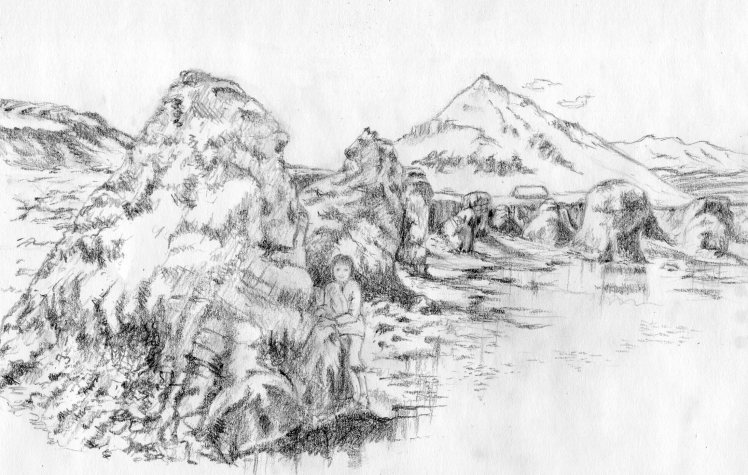
He crouched in the warm grit, listening hard for the approaching enemy who had cunningly disguised himself as the old Irishman Malachi. The crash of the surf and cacophonous gulls sounded further away now.
Helgi sat back and drew up his legs to brush the sand off his feet. Removing his sturdy leather boots from around his neck, he unknotted the laces and pulled them on. He was wearing dark brown woollen trousers held up by a leather belt. His belt was buckled over his linen shirt and the grey kirtle, or long-sleeved, loose, knitted pullover, that he usually wore. From the belt hung a leather-bound sheath containing a long scramasax knife which he had named Footbiter.
He was not particularly large for his age, and that was a definite advantage when it came to hiding.
When out and about, and not hiding as he was at the moment, Helgi found it difficult to be inconspicuous. This was because his appearance was striking. His hair was dark and hung in silky straps down to his neck. His broad face was fair, with a hint of rosiness on his cheekbones, which were pronounced and well-defined. He had an engaging smile. He had discovered very early in life that a well-judged smile, candid or conspiratorial, usually got him out of trouble and often got him his own way, so he smiled rather a lot. But his eyes were what caught people’s attention. They were wide-set, with an upward turn in the corners, and strangely expressive. When he was curious or challenged they lit up with a depth of blue that made his gaze intense and slightly disconcerting.
Wherever he went, people assumed he was foreign. He did not resemble his father or anyone else he knew. He couldn’t be certain whether he took after his mother, because he had no memory of her. Helgi’s father never talked about her—not to anyone, as far as he knew, and least of all to Helgi himself. The subject had always been completely off-limits.
In the old days, before they were exiled, Helgi’s father Halfdan used to leave their island home up in the north of Norway every autumn to lead an expedition. He would trade with the Sea-Finns who lived on the mainland coast, collect tribute from them, and then go inland to explore the mountains and forests that lay further east where Halogaland merged into Finnmark. Twelve years ago, he had returned home from his annual expedition bearing a tiny baby in his arms. The infant, a boy, was only a few months old, and weak and malnourished. Gerda, Halfdan’s housekeeper, took charge of him at once. She had always longed for a child of her own. She fed him on watered-down reindeer milk, a spoon at a time at first, since he was too sickly to take any more, and lovingly and anxiously watched him regain his strength and grow plump and rosy under her care.
Halfdan acknowledged that the child was his but would not say anything about how he had so suddenly and mysteriously acquired him. Gerda noticed he was taciturn, restless, and given to flares of temper. He left home again almost immediately, taking his ship and a small crew south along the coast to the royal estate at Kinsarvik in Hardangerfjord. The journey took several weeks because they hugged the intricate coastline and traded their goods whenever they came to a port. When Halfdan arrived, he delivered the valuable cargo he had taken from the Sea-Finns to the king’s administrators, and returned by the outer fairway, arriving home in late summer. As soon as the nights started drawing in he left the island, crossed once more to the trading post on the mainland to buy and take tribute in furs and ivory from the Finns, and journeyed east into the mountains again, accompanied by a small band of followers.
By the time he returned home the following spring, Helgi was toddling around. Halfdan seemed to notice the child for the first time. He bent down and picked him up, a little awkwardly. Gerda was afraid that Halfdan would do some violence to the child, for his expression had hardened into a terrible scowl. She hovered nearby, ready to fly to Helgi’s aid. But as Halfdan examined the child, something inside him seemed to crack and fall apart. He touched the soft round cheek tenderly with his calloused forefinger, and began to weep.
The infant Helgi took an instant dislike to the big, rough-skinned stranger, with the wild hair and weatherbeaten face, who had lifted him up in his powerful arms and scowled at him so fiercely. His lower lip trembled and he burst into tears. Gerda hurried over to take her charge away and comfort him. She didn’t know whom to pity more: the man who was grieving for the woman he had lost, or the motherless child who did not understand his own sad predicament.
When Helgi was almost three and old enough to ask questions, Gerda told him, as gently as she could, that she was not his mother, that his real mother was dead, and that Helgi was not to question his father about her because he could not bear to be reminded of his loss. Although he tried to suppress his curiosity about his mother, Helgi often felt it would have been easier to get on with his father if they had been able to talk about her. It would have cleared the air. But Halfdan maintained a brooding silence on the subject. The woman remained his secret. It was one of several reasons why Helgi was afraid of his father, and resented him sometimes.
Helgi tensed, hearing the voice again, closer now. He would have to stay where he was, or the imposter pretending to be Malachi would spot him. He wished the old man would go away.
The fall of the horse’s hooves on the turf sounded very close now. The game started to feel a little foolish. Helgi sighed deeply. It was better to create the impression of being busy and unavailable for other work than to be caught skulking about and doing nothing. The old man would only go telling tales to Gerda.
Helgi stood up and waved to Malachi with as much cheerfulness as he could muster.
‘Malky—over here! I thought I’d spotted some gull’s eggs—I was just having a look.’ Malachi hobbled over to him, leading the sturdy black horse. He was carrying something bulky under his arm. His baggy clothes hung loose on his wiry limbs and his face was framed by wispy grey hair and a long straggly beard. Two malicious bright eyes looked sceptically at Helgi.
‘So it’s bird’s eggs, is it?’ He gestured at the sky, where a bright haze, the sun at its zenith, lit up a scrap of windblown cloud. ‘Look at the time—it’s midday! You’ve been gone so long, Gerda thought you must have gathered too much wood to carry and told me to bring the horse. But we won’t need him, unless it’s to carry all the eggs you’ve found, of course.’
He thrust the bundle into Helgi’s hands. ‘You put the bags on him; he tried to bite me, the brute!’
‘The nest turned out to be too difficult to reach. And there wasn’t much driftwood around today,’ said Helgi, feeling the corner of his mouth twitch as he tried to suppress a smile.
‘There was a storm the other night so plenty of wood should’ve washed up on the shore,’ Malachi exclaimed, gesturing in the direction of the beach. ‘I can’t possibly bend to pick up driftwood at my age—not with my bad back. Your bones are younger than mine! Still, it’s too much to expect any help from an idle young fellow like you.’
Helgi tried a different tack.
‘If you’ve brought Kol, I could go up to the pastures and check on the sheep instead.’
‘If Gerda’s got any sense, she’ll give you a job indoors where she can keep an eye on you. Then you might get some work done for a change,’ said Malachi grumpily.
Helgi stroked Kol’s nose and fondled his coal-black shaggy mane. Kol tried to nuzzle his hand, hoping for a treat. The horse didn’t belong to Helgi—he had been lent to him by his uncle—but Helgi had formed a close attachment to him since arriving in Iceland. His uncle had given him permission to look after Kol personally. Kol stood out from the other horses because of his intelligence and a wayward, independent streak, which Helgi found appealing. It often seemed to Helgi that Kol understood everything he was feeling.
The farmstead where Helgi now lived was built in a wide grassy valley that sloped up to the foot of Stapafell. Sheep grazed on the higher ground, but never roamed far up the barren black sides of the volcano itself. The valley ran down towards the sea and ended in a smooth, grass-grown headland which jutted out into the bay. Helgi took hold of Kol’s halter and the three of them set off up the headland. He could not feel the onshore breeze now and a few rays of late summer sunshine seeped through a gap in the shifting clouds. Ahead of them lay the low, grass-roofed longhouses of his uncle’s farm and the stone wall that ringed the hay meadow.
‘I shouldn’t have to spend my time chasing after you,’ Malachi muttered. ‘God knows, I’ve devoted enough of my years to serving your father and looking after the old place. I deserve a bit of peace at my time of life, and a comfortable seat by the fireside. I certainly didn’t expect to be dragged off to a whole new country and have to start again from scratch!’
Helgi smiled. Being with Kol put him in a cheerful mood which not even Malachi’s grumbling could sour.
‘Perhaps you should have stayed in Norway.’
‘That’s a ridiculous suggestion if ever I heard one! With your father’s enemies laying siege to the place—I wouldn’t have stood a chance.’
‘Well, if you’re tired of living with us, why not ask for your freedom? My father’s offered it to you many times.’
‘Freedom’s all very well, but where would I go? A poor old man like me. With my weakened constitution—’ Malachi broke off, inhaled deeply, spluttered, wheezed, and produced a racking cough that sounded quite convincing. ‘I’m not fated to live in this world much longer…’
Old humbug, Helgi thought.
‘Well, I’m glad you came with us, Malky—you’re one of the family. I can’t remember a time without you.’
‘Well, you wouldn’t, seeing as your father acquired my services many years before you were born, when he was fighting the High King of Tara in Dublin.’
‘Tell me about it,’ said Helgi with genuine eagerness, though he had heard this piece of family history many times before.
Malachi could never resist telling his life-story.
‘Well, I first met your father Halfdan when he was a young man—not much older than yourself. He wanted to establish his reputation and see a little of the world before settling down. He knew he would inherit his father’s estate one day and all the rights and responsibilities that entailed—the Finn trade, and so on—and I suppose he wanted to have a bit of fun first. Anyway, he and his brother got a passage on a ship bound for Ireland—at the time it was a popular destination for raiders. Easy pickings to be had there, what with all the monasteries dotted about, packed with treasures and completely undefended.
Now my mother, Fidelma, was an Irish woman, but my father was a Norseman of noble stock, by the name of Toki Gudmundson. I never knew him because he left us behind in Dublin when I was a child. It was difficult for us children of mixed blood—being neither fully Irish nor fully Norse we found it hard to be accepted by either side. But the Norsemen were rebuilding their stronghold at Wood Quay so it was easy to find work as a labourer when I grew up. My master was a viking who spent most of his time robbing churches. I didn’t approve of that, but what could I do? He got me to hide a cache of stolen treasure. Every now and then I would go and check on it, to see that it was safe. The holy cross I wear round my neck was one of the most beautiful jewels in the hoard.’
Malachi brushed aside his straggly beard and pulled out a chain on which hung a large, heavy pendant: a silver cross surmounted on a ring of silver; the circle and shafts of the cross were intricately ornamented. He ran his bony finger fondly over the surface which was engraved with abstract pattern of spirals, loops, and endless three-sided knots.
‘You can see why this was my favourite piece. It was so special that I hid it separately from the rest of the hoard.’
‘Can I hold it?’
‘All right, but be careful.’
Malachi slipped the chain from his neck and laid it carefully in Helgi’s hands. The pendant felt heavier than he expected. Its intricate design reminded Helgi of the tangled interlace carving he had seen on sword-hilts, door posts, and the gunwales of ships, except it was less exuberant and disorderly, and there were no fabulous birds and wild beasts hidden within the pattern.
‘Does it have a magical power?’ asked Helgi.
‘Well, I don’t use it for magic. But it’s saved my life on more than one occasion. The cross stands for salvation, you see. The circle and the little knots in the pattern have no beginning and no end. They are symbols of eternal life.’
Helgi nodded politely, though he did not understand a word of Malachi’s explanation, and handed the cross back. Malachi hung it around his neck and yanked out his beard from beneath it, and they walked on in silence for a while.
Then Helgi said, ‘Tell us the rest of the story, Mal.’
‘Well, the King of Tara, Niall Black-knee, and the northern kings who were under his command, came to Dublin with a big army—they wanted to drive out the Norsemen who occupied the city. It looked as if there would be war, so my master says, “Malachi, bring me the treasure at once! I don’t want it to fall into the wrong hands.” But when I got there all but the cross had gone! Someone had dug up the main hoard and stolen it! I couldn’t go back to my master empty-handed—he was a hard, cruel man and I knew he would blame me for losing the treasure and most likely thrash me to death. So I took the cross, which I hid under my clothes, and fled. I went to the King of Tara and offered him my services. I found myself fighting the Norsemen at Islandbridge. To think that I had helped build the walls that we were now attacking! Such confusion and terrible slaughter! There were spears and arrows raining down on us, but I hid under my shield and the cross around my neck protected me. It was very unpleasant being on the losing side, and I was glad to surrender to your father. Some of us Irishmen were taken off on the vikings’ ships, to be sold as slaves. But I was luckier than most. When Halfdan heard about my distinguished Norse ancestry, he took me into his service and even let me keep the cross.’
‘I wonder what became of the rest of the treasure,’ said Helgi thoughtfully.
‘I like to think it’s still in Ireland, but those were turbulent times – it could have ended up anywhere. It’s remarkable where valuable treasures can turn up! People too, like you and me, are all too easily caught up in big events and carried along like flotsam in a storm, only to be dropped ashore somewhere quite different.’
‘Like when we came to Iceland,’ murmured Helgi.
Shattered lives, torn from their roots, tossed from one place to another, like debris drifting on the waves.
They had almost been wrecked too—right at the end of the crossing to Iceland, just when they were congratulating themselves on having made it. They had been so close that they could see land—a vast plateau looming on the starboard side, and before long they were skirting islands. Helgi had leant over the side, watching the isolated crags and patches of rock slip by, relieved that the long crossing would soon be over and anticipating the moment when they would drop anchor and launch the little rowing boat, which would take them ashore, where he would jump out into the surf and run up the beach. But the wind had stiffened and changed, the waves began to swell, and they found themselves driven back out to sea. Dark, menacing clouds obscured the land and sky, the wind rose, the boat began to surge and pitch as huge crests of water rolled up from behind and lifted the hull before crashing over the side and drenching them in ice-cold spray.
The storm had pounded the ship all night, threatening to smash the hull to pieces or sweep them towards the lethal outcrops of rock. Helgi had wanted to help with the baling, but was so sick that he could barely stand upright. He crawled inside a cramped space in the hold, which was already jammed with spare bits of gear and equipment, and curled himself in a tight ball—shivering, wet and frightened, and feeling terribly ill. Malachi squeezed in next to him. His face was chalk-white in the darkness, his eyes staring blankly in terror, and lips moving in silent entreaty. Below them, the ocean heaved and churned, relentless and indifferent. All they could do was endure the rolling, pitching blackness, the deafening roar, the stinging spray, and the freezing puddle they sat in, which grew ever deeper as salt-water poured off the deck and into the hold—and console themselves with the thought that it couldn’t go on forever.
Helgi did not like to think of himself as a person rendered powerless by stormy events outside of his control.
‘But Malky, we weren’t just “caught up and carried along”,’ he objected. ‘We chose to fight. It was our choice. And we survived the battle in Norway—and the storm off Iceland—because we were strong and determined and we stuck together.’
Malachi shook his grey head. ‘Being brave and strong counts for very little when you’re caught in a storm and battling the elements. What are you—compared to the terrible anger of the sea? Nothing at all!’
He wheezed with mocking laughter.
‘Our ship held together—we mastered the storm,’ said Helgi indignantly.
‘You Norsemen are such proud and arrogant fellows! You think you can conquer the sea and displace the Ruler of the world—that all it takes is a few planks of wood beneath your feet! Let me tell you, no man has the power to decide his own fate. It was God who preserved us in our time of need.’
‘I think our own actions matter more than the gods,’ said Helgi. ‘If anyone deserves the credit for preserving us, it’s my father.’
‘Ah, yes—your father. He he he!’ Malachi chuckled.
‘What’s so funny?’
‘Well, I’m only a servant and it’s not my place to tell people how to conduct their lives. But if our losses have taught us anything, it’s a lesson that your father, in particular, would do well to heed …’ Malachi said sententiously, raising his finger to point it out.
Helgi could feel his temper rising. Malachi was always lecturing him and he hated it.
‘ … Which is that it’s foolish and vain to strive after glory in this unstable world. Fame and wealth can provide no lasting security. Look at your father, young man, and consider how the mighty are fallen. It grieves me that he has learnt nothing from his misfortunes. All he can think of is grabbing back the power that slipped so easily through his fingers in the first place …’
Helgi quickened his pace, irritated by Malachi’s taunts.
‘… A wiser man would turn his back on thoughts of vengeance and put his trust in God, but your father refuses to listen to reason.’
Helgi turned on him angrily. ‘At least he stands up for himself! My father doesn’t bow down to anyone—not even the gods! Why should he trust any gods after what happened? He prefers to rely on his own strength. And so do I,’ he added with fierce conviction.
‘You may have to do just that,’ said Malachi, ‘and sooner than you think. Thorgrim Ericsson and his brothers called by earlier. They were looking for you.’
‘Thorgrim?’ Helgi faltered and a worried look came over his face. ‘What did he want?’
‘The youngest Ericsson wants a word with you.’ Malachi chuckled maliciously and hobbled on ahead, past the farmstead where Helgi’s uncle lived, towards a cluster of smaller longhouses further up the hill—leaving Helgi to absorb his parting shot.
 The Adventures of Helgi the Viking